

Is the Garmin Race Predictor Accurate? Mine Nailed My 5K and Missed My Marathon by 10 Minutes
My Garmin Forerunner 255 predicted my 5K to within 10 seconds on a hot, hilly morning. Its marathon prediction is about 10 minutes off. Here is why the gap exists and how to use the race predictor the right way.
Ask a group of runners about the Garmin Race Predictor and you'll get two opposite answers. Some swear it called their race down to the minute. Others say it spits out marathon times they couldn't hit in their wildest dreams.
I've got both stories on the same wrist.
I train with a Garmin Forerunner 255. A couple of months ago I ran a local 5K on a brutally hot, humid Iowa morning, on a course full of rolling hills. The time my watch predicted looked ambitious for those conditions. I finished 10 seconds off it. On a day that was working against me in every way, that's a pretty impressive call.
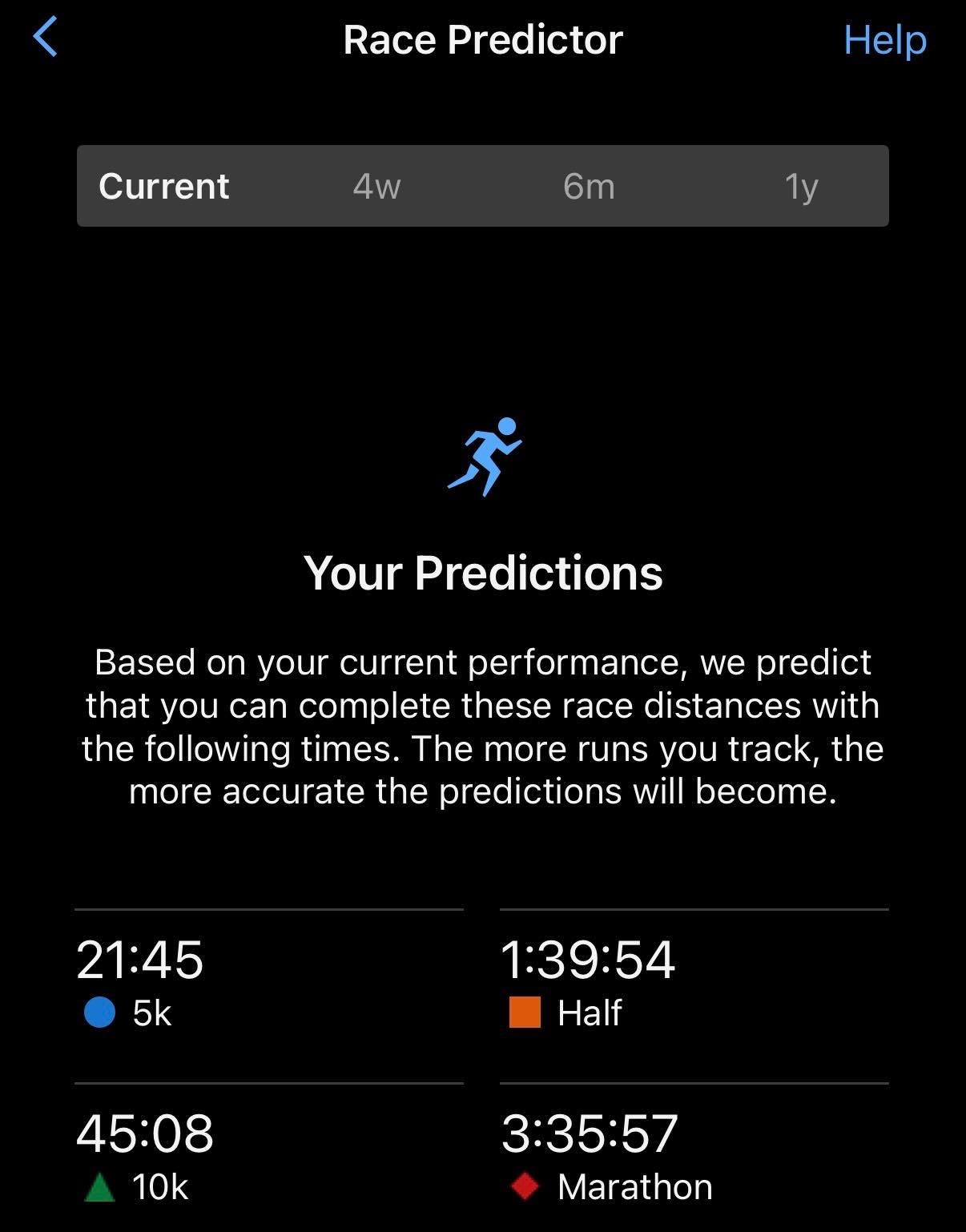
The marathon is a different story. The marathon time on my watch is about 10 minutes too fast. Same watch, same legs, same fitness data. So what's going on?
Here's how the predictor actually works, why it nails short races, why the marathon number runs rosy, and how to get more out of it.
What's In This Guide
What the Race Predictor Actually Does
Your watch gives you four predictions: 5K, 10K, half marathon, and marathon. They start with your VO2 max estimate (what VO2 max actually means), which the watch builds by comparing your heart rate to your pace on outdoor runs. A fitter runner holds a faster pace at a lower heart rate, and that's the pattern the watch is looking for.
Older Garmins worked almost like a lookup table. Same VO2 max, same predictions, for everyone. Newer watches add your training history on top. Firstbeat, the company behind Garmin's fitness numbers, says it looks at your weekly mileage trends, your training load trends, and how much your longer runs contribute. Garmin doesn't publish how heavily any of that is weighted.
One more thing worth knowing: Garmin itself says to treat the predictor as a guideline, not a hard prediction. A Garmin UK product manager said as much when TechRadar asked how accurate it really is.
Why It's So Good at the 5K
A 5K is mostly an aerobic effort. Your heart and lungs are the limiting factor, and those are exactly what a VO2 max estimate measures. There's also very little room for things to go wrong. You don't need a fueling plan for 20 minutes, a pacing mistake is cheap, and your legs aren't going to fall apart before the finish line.
That's why my 5K prediction held up even with the weather and the hills fighting me. If you want to know how much heat really costs you on race day, we've got guides on beating the heat and running in the heat.
Why the Marathon Number Runs Rosy
The marathon is a different kind of hard. Your heart and lungs are only part of it, and the rest is invisible to a wrist sensor. Here's what the watch can't see:
- Your fueling. Running out of glycogen at mile 20 has nothing to do with VO2 max. Whether your gel plan actually works matters more than most people think, and we cover it in our race fueling guide.
- Your pacing discipline. Going out too fast in the first 10K wrecks a lot of marathons. The watch assumes you'll run it perfectly, and that's a big assumption. Our race morning guide covers how to avoid it.
- Your leg durability. Mileage tells the watch you run a lot. It can't tell whether your legs will still hold their form at mile 22. That's where long runs done right and good running form pay off.
The5krunner puts it this way: the predictor is driven by aerobic fitness and can't model those late-race demands. Runners without marathon-specific training often find the predicted time is 30 to 60 minutes faster than they can actually run. Mine is only about 10 minutes off, hopefully, so I'm getting off easy.
For a sense of scale, that same source notes Firstbeat's own testing shows about 5 percent average error on VO2 max estimates under controlled conditions, and wrist-based data in the real world tends to do worse. Five percent of a four-hour marathon is 12 minutes. That's a rough comparison, not a precise conversion, but it tells you a 10-minute miss isn't shocking.
Three Ways to Get Better Predictions
If your numbers feel off, start by cleaning up the data going in.
1. Fix your max heart rate. Garmin's product manager tells users to keep their height, weight, resting heart rate, and max heart rate up to date. Many watches start with an age-based guess like 220 minus your age, and that formula misses by 10 beats or more for plenty of runners. If your max is set too low, the watch thinks you're working harder than you really are at a given pace, which can drag your fitness estimate down. To find your real number, run hard hill repeats or empty the tank at the end of a 5K, then update your profile in Garmin Connect.
2. Use a chest strap for hard runs. Wrist sensors sometimes lock onto your cadence instead of your pulse, a glitch called cadence lock. If your heart rate suddenly reads 170 on an easy jog, that's probably what happened. Bad heart rate data can make you look less fit than you are, and a chest strap fixes it. We've got more on why cadence matters if you want to go deeper.
3. Run outside, and keep it consistent. Garmin's product manager says you need to run outside for the watch to gather VO2 max data, so treadmill-heavy weeks mostly won't move your numbers. Steady, easy running gives the cleanest data, and that's most of your mileage anyway. Our zone 2 guide explains how to run those days right.
Don't Panic During a Taper
Some runners report their predictions slipping when their running drops off. Since Garmin factors in training history, it wouldn't surprise me if a taper nudges the numbers the same way. If that happens, it's most likely the watch seeing less running, not you losing fitness.
So if your predicted time gets a little worse in race week, leave your plan alone. Our tapering guide explains why cutting volume works, and the race morning guide covers what to do once you're on the start line.
How I Actually Use It
I treat the predictor as a trend tool, not a race-day forecast. If your predicted 5K goes from 22:30 to 21:45 over eight weeks, your fitness is moving the right way, no matter what happens on one hot morning. The5krunner's take is similar: it's a good marker of progress, not a precision target.
| Instead of this | Do this |
|---|---|
| Setting your marathon pace from the watch's number | Set it from a recent real race result |
| Panicking when one hot, humid run drops your prediction | Watch the trend over an 8 to 12 week block |
| Trusting the marathon prediction on modest weekly mileage | Use the 5K and 10K numbers as ballparks for interval paces |
For race-day pacing, use a real result. Plug a recent race into our pace calculator, or build a free training plan that sets your paces from your actual fitness instead of a heart rate guess. If you're still picking a target, our goal pace guide helps you set an honest one.
Other brands have their own versions of this. Coros has one inside its EvoLab metrics, for example, and the same rule applies. If you're shopping for a watch partly for the training data, check out our best running watches of 2026, the Coros Pace 4 Pro review, or the Watch Finder. And here's the Forerunner 255 I use.
The bottom line: the 5K prediction is a solid ballpark, and the marathon number is what happens if everything goes right. Use the watch to track your progress, and use your real races to set your goals.
Want race targets based on real results instead of watch algorithms? Build a free training plan or use our Shoe Finder to pair your training with the right shoes.
This article contains affiliate links. If you purchase through them we may earn a small commission at no additional cost to you.
Related Articles
How Accurate Is Your Watch's Heart Rate? Garmin, Coros, Polar, and Apple Explained
Your watch's heart rate isn't magic, and it isn't always right. Here's how wrist heart rate actually works on Garmin, Coros, Polar, and Apple, what throws it off, and when a chest strap or armband is worth it.
9 min readGarmin Forerunner 255 Review: 2 Years Later, Is It Still Worth It in 2026?
A real 2-year ownership review of the Garmin Forerunner 255. Battery life, training metrics, running dynamics, durability, and who should buy it instead of an Apple Watch or the newer Forerunner 265.
5 min readCadence: What is it and does it really matter?
We are told 180 steps per minute is the magical running cadence. But forcing short, choppy steps or overstriding to chase speed is a recipe for injury. Here is how stride mechanics actually work.
5 min read
Phil Parker
Phil is a seasoned distance runner and web developer based in Iowa. He has run 15+ half marathons and 3 full marathons, and built PR Nerd because he was tired of paying for running apps that did not use real training science.
More about Phil →Follow on Strava →Comments
No comments yet. Be the first.
Leave a comment
Not published
0/1000
Ready to put this into practice?
Build your free personalized training plan based on your actual fitness — not your goal.
Build my plan →Get monthly running research, pace strategies, and fresh training articles. Zero fluff.