

The 10 Best Running Watches of 2026, Ranked by the Numbers
No sponsorships, no brand loyalty, no guessing. We ranked every watch in our catalog by real Amazon ratings, actual feature sets, and MSRP, and this is what came out on top.
Most "best running watches" lists are really just "watches the site likes best," dressed up with a ranking. We didn't want to do that. So instead of picking favorites, we ran every watch in our own comparison database through the same three-part scoring system, no exceptions, no brand gets a pass, and let the numbers decide the order.
Here's the actual top 10 that came out of it, and exactly how we got there.
How We Actually Ranked These
Three inputs, and only three. No sponsorships factor in, and no brand gets weighted higher just because we personally like their gear.
Real Amazon customer ratings, pulled as of August 2026. Not our opinion of how a watch feels on a run, the aggregate rating from people who actually bought it. Ratings shift over time as more reviews come in, so if you're reading this well after publication, it's worth a quick gut-check against the current number on Amazon.
A hard feature checklist, not a vibe. Every watch either has dual-band GPS or it doesn't. Either has real offline maps or it doesn't. Either supports wrist calls or it doesn't. Either reaches our top analytics tier or it sits a level below. These are yes/no facts pulled from each watch's actual spec sheet, not marketing copy.
MSRP, not a sale price. We used manufacturer list price across the board so no watch gets an unfair boost from a temporary discount that might be gone by the time you read this.
The formula weighs rating and features together into a quality score, then applies a price penalty that scales with cost, not one that just crowns whatever's cheapest. A watch has to actually justify its price with real capability and a real track record to rank highly here. A $99 watch doesn't win by default for being $99, and a $1,000 watch doesn't win by default for being expensive. Every watch on this list earned its spot the same way: quality that holds up against what it costs.
Why the Garmin Fenix 9 Isn't Here
You'll notice the Fenix 9 lineup is absent, and that's deliberate, not an oversight. It's simply too new to have a real customer rating yet. Rather than guess at where it would land, or lean on early marketing buzz, we're leaving it off entirely until it has an actual track record behind it. We'll revisit this list once that exists.
The 10 Best Running Watches of 2026
1. Amazfit Cheetah 2 Pro

Amazfit Cheetah 2 Pro
Amazfit's first truly serious dedicated running watch.
The Cheetah 2 Pro checks every box a serious runner actually needs: dual-band GPS, real offline maps, wrist calls, and our top analytics tier, all for less than half of what Garmin or Suunto typically charge for the same list. At 34 grams on a 46mm case, it's also one of the lightest fully-loaded watches on this entire ranking, which matters more than it sounds like it should once you're a few hours into a long run.
This is the pick for someone who wants a genuinely complete training watch and refuses to pay flagship pricing to get there. If you're coming from a basic GPS watch and want every real feature at once, dual-band accuracy, real maps, the ability to leave your phone at home, this is the most complete jump you can make for $449.
Where it comes up short is brand ecosystem and long-term track record. Amazfit's software and app support isn't as deep or as mature as Garmin's, and if you're the type of runner who wants a decade of accessory and app-store support behind your purchase, that's a real, fair consideration. It's also worth cross-shopping directly against two other watches on this list: see how it stacks up against the Garmin Enduro 3 if battery life matters more to you than price, or against the Garmin Forerunner 970 if you're weighing Garmin's ecosystem against Amazfit's price.
2. Suunto Vertical 2

Suunto Vertical 2
Suunto's rugged flagship finally swaps its old MIP screen for AMOLED and adds a built-in LED flashlight.
Same fully-loaded feature set as the Cheetah 2 Pro, dual-band GPS, offline maps, wrist calls, top-tier analytics, but backed by a higher rating and a serious jump in raw GPS battery life at 65 hours. It's also the newest hardware generation in Suunto's lineup, having just moved to a bright AMOLED display and added a built-in LED flashlight that its predecessor didn't have.
This is the watch for someone who spends real time outdoors past the length of a normal training run, think ultras, multi-day hikes paired with running, or anyone who's been burned by a watch dying mid-adventure. The 87-gram weight and 49mm case reflect that outdoor-first design.
That size and weight is also exactly why it's not the right pick for everyone. If you want something that disappears on your wrist for daily training runs, this is noticeably bulkier than the Cheetah 2 Pro or the Coros Pace 4 further down this list. Worth comparing directly against the Garmin Enduro 3, which trades Suunto's AMOLED display for even more raw battery life, or against its own predecessor, the original Suunto Vertical, if you're wondering whether the upgrade is actually worth it.
3. Amazfit Balance 2

Amazfit Balance 2
Amazfit's daily-driver smartwatch, with genuine training tools underneath.
A genuinely full-featured watch at a price that usually only buys you a lifestyle tracker. Real training analytics, dual-band GPS, offline maps, and wrist calls, all under $250. That combination is rare this far down the price ladder, and at 35 grams it's barely heavier than the far more expensive Cheetah 2 Pro.
This is the pick for someone who wants Garmin-adjacent functionality without spending Garmin money, especially someone who cares as much about daily wellness tracking as they do about pure running metrics. Amazfit built this line with a lifestyle-first lean, so it handles sleep, stress, and recovery tracking a step above most pure running watches at this price.
It sits a tier below the Cheetah 2 Pro and Suunto Vertical 2 on our top analytics tier, so if you're training for a specific race with structured, data-heavy workouts, you may eventually outgrow what it tracks. Compare it directly against the Amazfit Active 3 Premium if you're deciding whether the extra $80 for dual-band GPS and deeper analytics is worth it over Amazfit's cheaper option.
4. Amazfit Active 3 Premium

Amazfit Active 3 Premium
Offline routable maps and real running tools, at a shockingly low price.
The highest-rated watch under $200 on this entire list. It trades dual-band GPS for single-band to hit that price, but still packs offline maps, wrist calls, and real training analytics that most budget watches skip entirely.
This is the pick for someone just getting serious about running who doesn't want to gamble $400 or $500 on a hobby they're not sure will stick, or for an experienced runner who simply doesn't run in conditions (dense forest, deep urban canyons) where single-band GPS accuracy becomes a real problem. For most road and open-trail running, the accuracy difference from dual-band is smaller than the spec sheet makes it sound.
If you do train somewhere GPS signal is genuinely difficult, tree cover, canyon roads, single-band accuracy is the one real trade-off here, and it's worth stepping up to a dual-band watch instead. See how it stacks up against the step-up Amazfit Balance 2, or against the Amazfit Active Max if you want to compare it to the other budget Amazfit pick on this list.
5. Amazfit T-Rex 3

Amazfit T-Rex 3
A military-grade rugged AMOLED watch that undercuts Garmin and Suunto's outdoor flagships by hundreds of dollars.
The rugged pick. Dual-band GPS, offline maps, and a genuinely tough build for a fraction of what Garmin or Suunto charge for similar durability, backed by 42 hours of GPS battery life. At 65 grams it's noticeably heavier than the lifestyle-leaning Amazfit watches higher on this list, but that weight comes from real MIL-STD-810G durability testing, not padding.
This is the watch for someone who's hard on gear, trail runners, people who work outdoors, anyone who's cracked a screen or snapped a band on a lighter watch before. It's built to take a hit that would end most other watches on this list.
If your runs are mostly road miles in controlled conditions, you're paying for ruggedness you won't use, and a lighter watch will be more comfortable over a long run. Worth comparing directly against the Garmin Fenix 8 if you want to see exactly how much you're saving by going with Amazfit over Garmin's rugged flagship, or against the Garmin Enduro 3 if extreme battery life matters more to you than price.
6. Garmin Forerunner 970

Garmin Forerunner 970
Garmin's flagship running watch, and it delivers.
The first Garmin to crack this list, and it earns the spot. Top-tier analytics and wrist calls inside Garmin's own ecosystem, at a price that, for once, isn't wildly out of step with what you actually get for it. At 56 grams on a 47mm case, it's built specifically for runners rather than as a general do-everything smartwatch.
This is the pick for someone specifically bought into Garmin Connect already, or who wants the deepest running-specific training load and recovery metrics on the market, without paying full Fenix pricing to get them. Garmin's training analytics are still the benchmark the rest of the industry gets compared against.
The tradeoff is straightforward: you're paying a real premium for the Garmin name and ecosystem over an Amazfit or Coros watch with a nearly identical spec sheet. If that ecosystem lock-in doesn't matter to you, the money is better spent elsewhere on this list. Compare it directly against the Amazfit Cheetah 2 Pro to see exactly what that premium buys you, or against the Garmin Enduro 3 if you're deciding between Garmin's running specialist and its battery specialist.
7. Garmin Enduro 3

Garmin Enduro 3
Built for runners who measure training blocks in weeks, not days.
Ninety hours of GPS battery life. That's not a typo, and nothing else on this list touches it. If battery life is genuinely your top priority, this is the watch that earns its $899 price tag on that spec alone, backed by a 4.7 rating and Garmin's full top-tier feature set.
This is the pick for ultra runners, multi-day adventure racers, or anyone whose real complaint with every other watch has been charging it mid-training-block. Nothing else here comes close on raw endurance.
For a normal training block of road or trail runs measured in single-digit miles, this is genuine overkill, and the $899 price tag is hard to justify against watches on this list with nearly identical everyday features for half the cost. Compare it against the Amazfit Cheetah 2 Pro to see just how much of that price is battery life alone, or against the Suunto Vertical 2 if you want AMOLED color without giving up much runtime.
8. Coros Pace 4

Coros Pace 4
The best all-around value in running watches right now.
The highest-rated watch in this entire ranking, full stop, at 4.8 stars. Dual-band GPS and offline maps (added via a recent firmware update, not something baked in at launch) for $249. At 40 grams on a 43mm case, it's also one of the smaller, lighter watches on this list.
This is the pick for someone who wants Garmin-level training data without the Garmin price or the Garmin bulk, especially a runner who doesn't care about taking calls from their wrist and would rather have that money go toward GPS accuracy and mapping instead.
The one real omission is wrist calls, which the Cheetah 2 Pro, Balance 2, and several other watches on this list do include at a similar price. If that feature matters to you, it's worth knowing before you buy. Compare it directly against the Garmin Forerunner 265 to see how it stacks up against a similarly-priced Garmin, or against its own predecessor, the Coros Pace 3, to see exactly what the upgrade added.
9. Amazfit Active Max
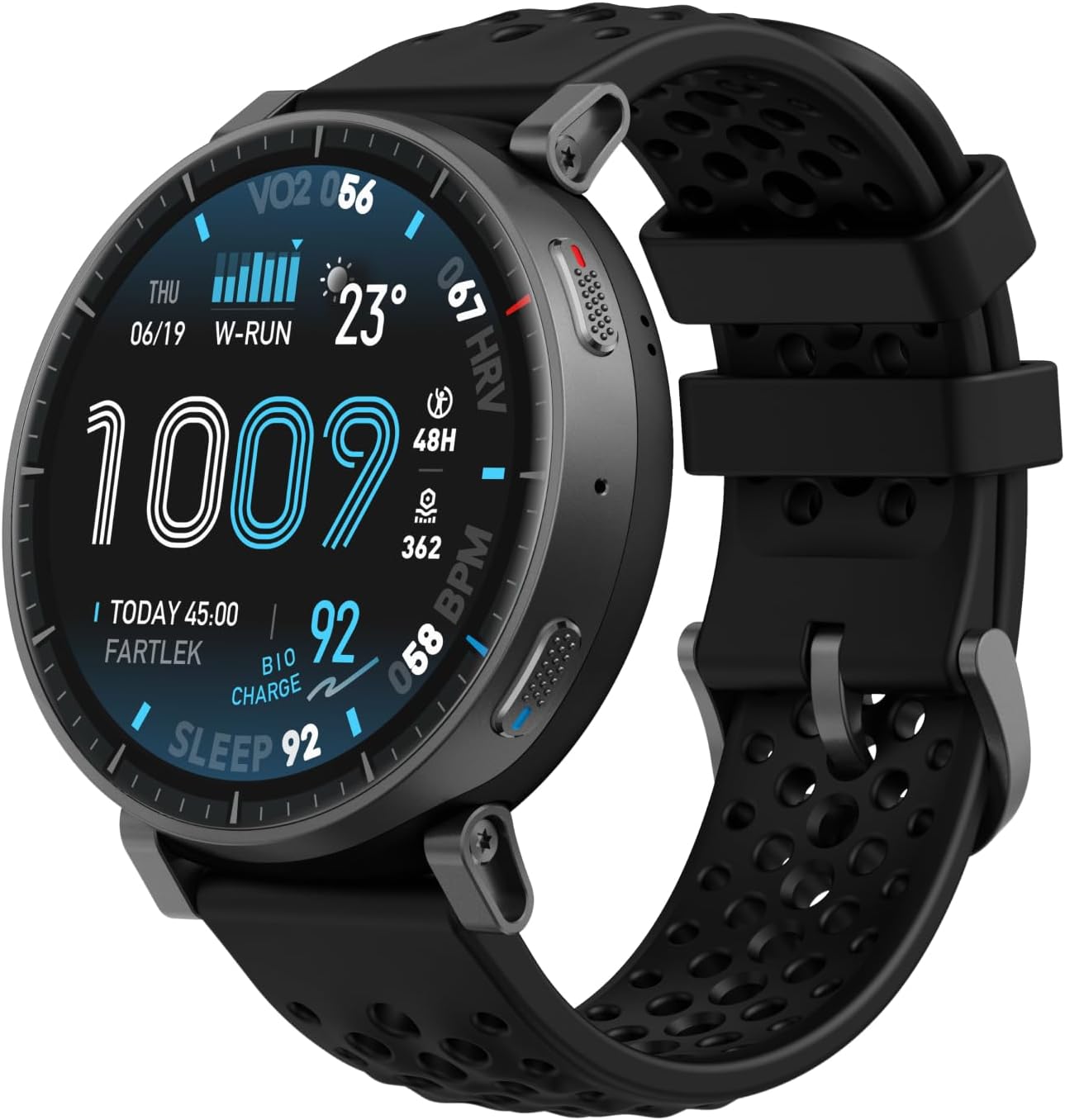
Amazfit Active Max
A bright, long-lasting all-rounder for under $200.
A strong all-around budget pick, anchored by a genuinely long 64-hour GPS battery life for its price bracket, plus offline maps and wrist calls that most watches under $200 don't bother including. At 40 grams on a 48mm case, it's a comfortable everyday size too.
This is the pick for someone who wants long battery life without paying Enduro 3 money for it, or anyone who's tired of charging their current watch multiple times a week. For the price, the battery-to-feature ratio here is hard to beat.
Like the Active 3 Premium above it in price, this uses single-band GPS, so if you run somewhere GPS accuracy is genuinely difficult, it's worth stepping up to a dual-band watch instead. Compare it against the Amazfit Active 3 Premium to see exactly what the $30 price difference between them actually buys.
10. Garmin Fenix 8

Garmin Fenix 8
Garmin's do-everything flagship, with calls, dive support, and a gorgeous screen.
The most expensive watch on this list, and the only reason it's here at all is a 4.7 rating and a complete feature set to back it up: dual-band GPS, offline maps, wrist calls, and Garmin's top analytics tier, available in 43mm, 47mm, and 51mm case sizes so it actually fits a wider range of wrists than most flagship watches bother to offer.
This is the pick for someone who wants Garmin's absolute best, the flagship build quality, the widest accessory and strap ecosystem, and the brand's longest track record, and has the budget where $999 isn't a real sacrifice to get there.
It's not a value pick by any definition, and several watches higher on this list offer a nearly identical day-to-day feature set for a fraction of the price. The Fenix 8 earns its spot on quality alone, not value, which is exactly the bar every watch on this list had to clear to make the cut. Compare it directly against the Amazfit T-Rex 3 to see just how much of that $999 is the Garmin name, or against the Garmin Forerunner 970 if you're deciding between Garmin's two best all-around options.
A List That Changes as the Data Does
This ranking isn't static. As ratings shift, as brands roll out firmware updates that add real features (like Coros just did with offline maps on the Pace 4), and as new watches build up an actual track record instead of launch-week hype, this list will move. That's the point of scoring it this way instead of just picking favorites.
If you want to see how any two of these stack up head-to-head, our Watch Finder has a full comparison tool for exactly that.
This article contains affiliate links. If you purchase through them we may earn a small commission at no additional cost to you.
PR Nerd builds your free personalized training plan with calibrated paces for every workout type. Build your plan here.
Related Articles
How to Pick the Right Running Watch (Without Paying for Features You Will Never Use)
Running watches range from $99 to over $1,000, and the marketing makes it worse. Here is what GPS accuracy, VO2 max tracking, AMOLED displays, and battery life actually mean, and how to figure out which features you will actually use.
9 min readCoros Pace 4 Pro: How It Actually Stacks Up Against the Pace 4, Forerunner 570, and Forerunner 970
The Pace 4 Pro just launched at $449 with ECG, a speaker, and real offline maps. Here's how the real spec sheet compares to Coros's own Pace 4 and Garmin's Forerunner 570 and 970.
7 min readGarmin Forerunner 255 Review: 2 Years Later, Is It Still Worth It in 2026?
A real 2-year ownership review of the Garmin Forerunner 255. Battery life, training metrics, running dynamics, durability, and who should buy it instead of an Apple Watch or the newer Forerunner 265.
5 min read
Phil Parker
Phil is a seasoned distance runner and web developer based in Iowa. He has run 15+ half marathons and 2 full marathons, and built PR Nerd because he was tired of paying for running apps that did not use real training science.
More about Phil →Comments
No comments yet. Be the first.
Leave a comment
Not published
0/1000
Ready to put this into practice?
Build your free personalized training plan based on your actual fitness — not your goal.
Build my plan →Get monthly running research, pace strategies, and fresh training articles. Zero fluff.