
Masters Running: How to Keep Getting Faster After 40
You can't outrun a bad diet anymore, but you can still get faster after 40. What changes for masters runners in training, speed work, strength, nutrition, creatine, warmups, and recovery, from a 44-year-old who just ran a 19-minute marathon PR.
This month, two of the best marathoners in history reminded everyone that 40 isn't the end of anything.
On October 11, Eliud Kipchoge won the Melbourne Marathon in 2:09:10, a course record and his first marathon win since 2023. He's 41. That same weekend at the Chicago Marathon, Galen Rupp ran 2:06:55 at age 40, a new American masters record.
Now, you and I are not Kipchoge or Rupp. But that's actually the good news. Elite runners have spent decades squeezing every last second out of their bodies. They have almost nothing left to gain, so for them, aging is a fight to slow the decline. Most of us are nowhere near our ceiling. We have room to improve in our training, our strength, our diet, and our consistency, and that room can more than make up for what we lose to age.
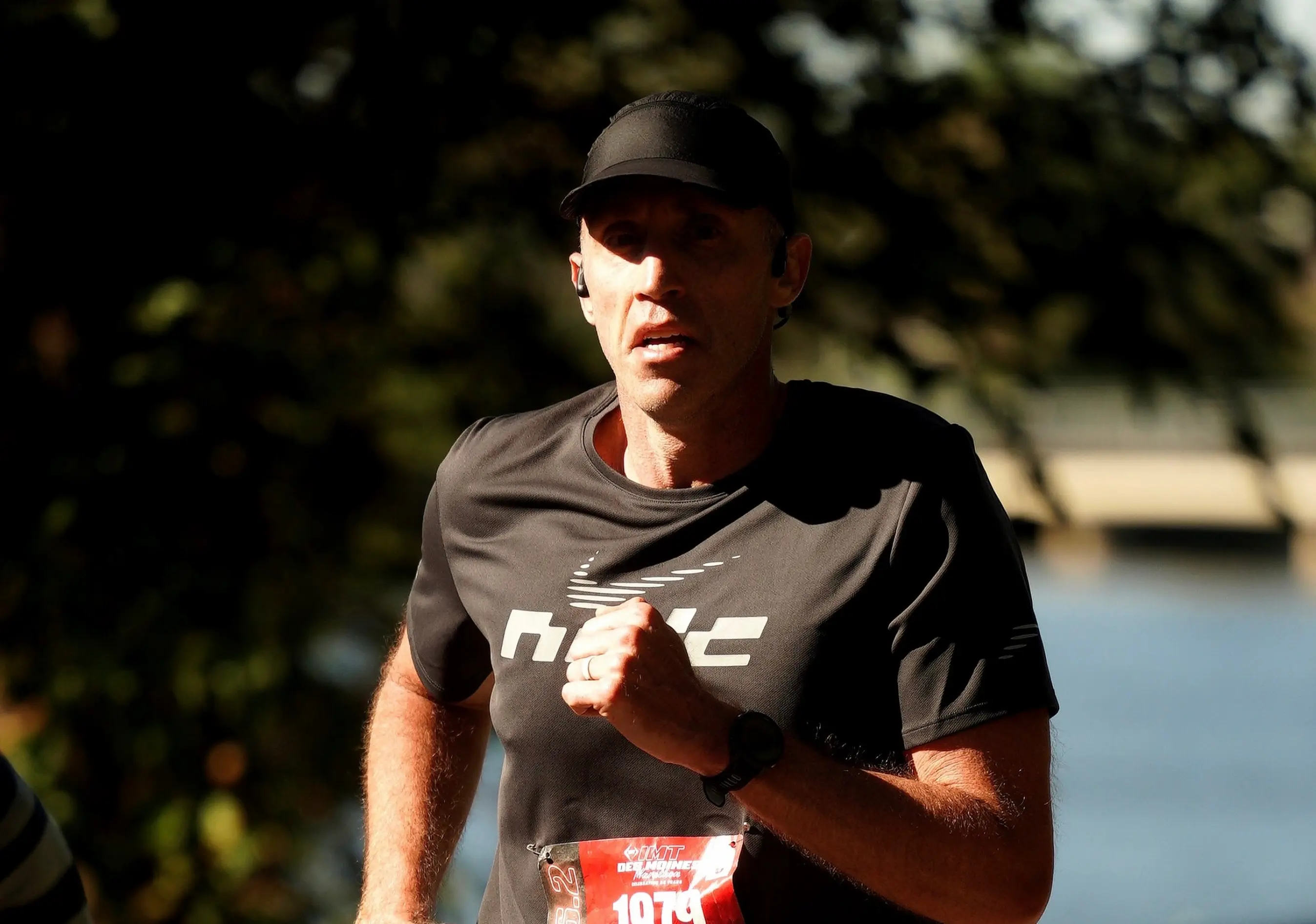
I'm living proof. At 36, I ran the Des Moines Marathon in 3:52. This October, at 44, I ran the same course in 3:33. Earlier in that same training block, I ran my fastest 5K in nearly 20 years. I wrote about the whole race in how I ran a 19-minute marathon PR at 44. But the bigger lesson is what I had to change to get there, because a lot of what worked in my 20s and 30s doesn't work anymore.
What Is a Masters Runner?
A masters runner is an older competitive runner, but where "older" starts depends on who you ask. World Athletics, the sport's international governing body, starts masters age groups at 35. Most road races, though, including the masters awards at big-city marathons, start the masters division at 40. That's the line most runners think of, and it's the one I'm using in this article.
You don't have to be fast or compete in masters races to count. If you're over 40 and still training to get better, you're a masters runner.
Can You Really Get Faster After 40?
Yes, with a caveat. Your physiological ceiling slowly drops with age, but the drop is smaller than most people think. A well-known review of masters athletes found that endurance performance holds up well into the mid-30s, then declines only modestly through the 40s and 50s, with the steeper drop-offs coming later in life.1
How you train matters a lot, too. In a classic 10-year study of competitive masters runners, the athletes who kept training hard and racing essentially maintained their VO2 max over the decade. The ones who backed off their intensity lost about 12%.2 Aging is real, but a lot of what we blame on age is actually a drop in training.
So if you're over 40 and you've never trained with a real plan, never lifted consistently, or never cleaned up your diet, you probably have a PR or two left in you. Maybe more.
You Can't Outrun a Bad Diet Anymore
In my 20s, I could eat and drink whatever I wanted and still run well. During heavy training periods, I would eat whatever junk food I wanted, like cookies, ice cream sandwiches, cupcakes, snack cakes, really anything. That's over. Your metabolism doesn't suddenly fall off a cliff at 40. In fact, a large study of daily energy expenditure found it stays remarkably stable from your 20s through about age 60.7 But most of us lose muscle, move less outside of our runs, and pick up habits that add up over time. The extra weight shows up faster and leaves slower.
I've lost 40 pounds since January 2025, and it didn't come from running more. It came from cleaning up what I eat and drink. A huge part of that was giving up alcohol, which I wrote about in why I quit alcohol. Less alcohol meant better sleep, better recovery, fewer empty calories, and fewer late-night bad decisions in the kitchen.
Every extra pound gets carried for every step of every run. If you're carrying extra weight, losing it can be one of the fastest ways to get faster after 40. But that doesn't mean every runner over 40 needs to get lighter. Underfueling can wreck your recovery, cost you muscle, and tank your performance just as surely as extra weight can, and masters runners have less margin for error there. If you're still in the "I run, so I can eat whatever I want" mindset, read why runners can't eat whatever they want.
Protein Matters More Than You Think
Most endurance runners think about carbs and forget about protein. That's a mistake at any age, but it's a bigger one after 40, when holding onto muscle gets harder.
Here's the encouraging part: research on active masters athletes suggests that if you keep training, your protein needs look a lot like a younger athlete's.3 The scary "older muscles stop responding to protein" findings mostly come from studies of inactive older adults. Exercise helps keep your muscles responsive.
The catch is that you actually have to eat enough. Needs vary with your size, training load, and goals, but a sports nutrition review from the Gatorade Sports Science Institute suggests a reasonable target for endurance athletes of around 1.8 grams of protein per kilogram of body weight per day, spread across about four meals of roughly 0.3 to 0.5 grams per kilogram each.3 For a 180-pound runner, that's around 145 grams a day, or about 35 to 40 grams per meal. Most runners I know are nowhere close.
I get most of mine from real food, and I use a protein shake to fill the gaps, especially after strength sessions and long runs.
Creatine Isn't Just for Lifters
I used creatine years ago when I was doing CrossFit, and it worked great. But I stopped when I got serious about running, because I'd always heard that creatine was bad for endurance athletes. It makes you heavier, and heavier is slower, right?
The research has shifted on that. A 2023 review in the Journal of the International Society of Sports Nutrition found that creatine can help endurance athletes, especially during surges, sprints, and finishing kicks, which are often the moments that decide a race.4 When taken with carbohydrates, creatine also improves glycogen storage, and it's well established as an aid to strength training. The review also suggests it may reduce inflammation.
It's not a magic pill, though. Results for straight time trials are mixed, and there's no strong evidence yet that creatine makes you faster over a full marathon. Where the evidence is strongest is strength training, and that's exactly where masters runners need the most help.
The trade-off is real, too. Creatine usually adds a pound or two of water weight, mostly stored in your muscles, and in a weight-bearing sport like running, that can offset some of the benefit. For masters runners, I think the strength and recovery benefits are worth it, especially in the off-season. That's why I'm getting back on it this winter, while I'm building strength for my next marathon.
Strength Training Is Not Optional
If there's one thing I'd tell every runner over 40, it's this: lift.
As we age, we lose muscle mass, and our fast-twitch fibers tend to take the biggest hit. That affects everything from your running economy to your injury risk to how well you hold your form at the end of a race. Two strength sessions a week kept me healthier than I've ever been in a marathon training block.
My focus is shifting more toward legs and hips. In the last few miles of my marathon, my hips were what gave out, and that's where I need the most work. Single-leg exercises, hip and glute work, hamstrings, and calves are where runners over 40 get the biggest payoff.
But I wouldn't drop upper body work entirely. In my last training block, I did more upper body strength work than in my previous marathons, and it showed. In the final miles of the race, a lot of runners around me had their arms flailing everywhere, but mine stayed compact and locked in all the way to the finish. A strong back and core keep your posture together when everything else is falling apart. I've cut out the size-building lifts like chest flies and shoulder presses, but I'm keeping the rows and core work.
If you've never lifted before, our guide to strength training for runners is a good place to start.
Don't Give Up Speed, Just Get Smarter About It
This is where a lot of masters runners go wrong, and it's personal for me.
Speed is usually the first thing to go as we age. Older sprinters take shorter strides and spend more time on the ground with every step, mostly because they're producing less explosive force.5 The common reaction is to stop running fast altogether. That's a mistake. If you never run fast, you lose the ability to run fast even faster.
The research says it doesn't have to be that way. In a study of elite masters sprinters aged 52 to 78, a 20-week program that combined sprint training with heavy strength work and plyometrics made them stronger, more powerful, and faster. Their 60-meter times dropped, their stride length increased, and they even added muscle, including fast-twitch fibers.6 Sports scientists who study aging sprinters recommend that older athletes keep regular exposure to high-speed running, along with consistent strength and power training.5
But "keep running fast" doesn't mean "keep doing all-out sprints like you're 20." Last summer, I pulled my groin doing sprints. It was the first injury like that I've ever had, and it was the last time I did all-out sprints. Your tendons and connective tissue don't bounce back like they used to, and maximum-effort sprinting puts a lot of stress on them.
So I still run fast all the time, just in a smarter way. I regularly run 400 and 800 meter repeats as interval workouts, along with tempo runs and threshold work. Those workouts keep my legs turning over quickly and build real race fitness without the all-out stress of a flat-out sprint. A few weeks before my marathon, I ran 7 x 800 at 3:26 with only 90 seconds of rest, which told me I was ready. If you want to know how to structure that kind of work, read our guide to tempo runs vs threshold runs.
The key is balance. Most of your miles should still be easy, and your hard days should be truly hard, because not every run should feel the same. If you want to bring back true sprinting, do it gradually, with short strides at the end of easy runs before you ever think about all-out efforts, and build up your hamstrings and calves in the weight room first.
Warm Up Longer Than You Think You Need
In my 20s, I could step out the door and start running fast. Now, my warmups are much longer, especially for my hips.
I've also moved away from static stretching, where you hold a stretch for 30 seconds, toward dynamic stretching before I run. Leg swings, hip openers, walking lunges, high knees, and butt kicks get the blood flowing and loosen up my hips without making my muscles feel flat. Before a workout or a race, I'll also do some easy running and a few strides before anything hard.
It feels like wasted time when you're in a hurry. It isn't. Those extra 10 minutes won't guarantee you stay healthy, but they make it a lot less likely you'll pull something.
Recovery: Consistency Over Rest Days
You'll often hear that masters runners need more rest days. That's not how it's worked for me.
Other than after a big race, I don't take full rest days. On days I don't run, I lift. My body is never completely idle, but it's also never getting hammered by running seven days a week. Swapping running for strength training on my off days gives my legs a break from the pounding while still building the strength that keeps me healthy.
Lifting isn't the same as resting, though. This works for me because my strength sessions are moderate and my easy days are truly easy. Recovery depends on your training load, sleep, injury history, and how your body handles stress. If you're stacking hard lifts on top of hard runs, you may need real rest days, and that's fine.
What I do take seriously is the difference between easy and hard days. My easy days are actually easy, and that's what lets me handle the hard ones. And I'm honest with myself about recovery taking longer. After my marathon, I was still sore going down stairs days later, which wasn't true in my 30s.
Everyone's different, and if your body is telling you it needs a full day off, take it. But don't assume that being over 40 automatically means more time on the couch. Consistency is still the whole game. If you're wondering about the long-term wear and tear, our article on whether running ruins your knees has some reassuring research.
Know Your Paces and Train From Your Current Fitness
One of the biggest mistakes masters runners make is training off old paces. Your 10K PR from 15 years ago doesn't tell you anything useful about what your tempo pace should be today. Train off old numbers, and you'll run your hard workouts too hard and your easy runs too fast, which is a quick way to get hurt or burned out.
Base your training on where you are right now. Use a recent race, even a local 5K, to find your current fitness, and build your paces from there. Our pace calculator will give you your training paces from any recent race time. Your watch's race predictor can help too, but it's not perfect, as we found in our look at how accurate Garmin's race predictor really is.
And when you're ready to put it all together, follow a real plan. I trained for my marathon on a free PR Nerd training plan, which paces every workout from your current fitness, not your goal time. Full disclosure: I built it, so I'm biased. But I followed it, I didn't skip days, and I ran a 19-minute PR at 44. If you're weighing whether to hire someone instead, I broke down the options in is a running coach worth it.
The Bottom Line
Getting older changes the rules, but it doesn't end the game. After 40, you can't outrun a bad diet, you can't skip strength training, and you can't treat your warmup like an afterthought. You have to be smarter about speed work, take protein seriously, and train off your current fitness, not who you were 10 years ago.
Do those things consistently, and you may find, like I did, that some of your best running is still ahead of you. I've been at this a long time, and I wrote about what the years have taught me in 20 years of running and what my best running year taught me. The short version is that it's never too late to get better.
Now I'm chasing a Boston qualifying time at 45. We'll see how that goes.
FAQ
Can you get faster at running after 40? Yes. Endurance performance declines only modestly through your 40s, and most recreational runners are far from their potential. Better training, strength work, diet, and consistency can more than make up for the effects of age. I ran a 19-minute marathon PR at 44.
Should masters runners still do speed work? Yes. Speed is often the first thing to decline with age, and regular fast running helps preserve it. Interval workouts like 400s and 800s, tempo runs, and strides are great options. Be careful with all-out sprinting, which carries a higher injury risk as you age, and build up to it gradually.
Is creatine good for runners? Research suggests creatine can help endurance athletes during surges, sprints, and finishing kicks, and it supports strength training and glycogen storage. Results for time trials are mixed, and there's no strong evidence yet that it improves marathon times. It often adds a pound or two of water weight, which is the main trade-off for runners.
How much protein do masters runners need? Research on active masters athletes suggests needs similar to younger endurance athletes. Needs vary by size and training load, but a reasonable target is around 1.8 grams per kilogram of body weight per day, spread across several meals of about 0.3 to 0.5 grams per kilogram.
Do runners over 40 need more rest days? Not necessarily. Many masters runners do well swapping running days for strength training rather than taking full rest days. Keep your easy days easy, recover well, and take a full day off when your body needs it.
Do masters runners need a GPS watch? You don't need one, but it makes training off your current fitness a lot easier. A GPS watch keeps your easy days easy and your workouts on pace, and it tracks your mileage so you can build gradually. You don't need the most expensive model, either. See our picks for the best running watches of 2026, or start with our running watch buying guide if you're not sure what features matter.
Should older runners stretch before running? Dynamic stretching, like leg swings, lunges, and hip openers, is a better choice before running than long static stretches. Older runners usually need a longer warmup than younger runners.
References
1. Tanaka H, Seals DR. Endurance exercise performance in Masters athletes: age-associated changes and underlying physiological mechanisms. The Journal of Physiology. 2008;586(1):55-63.
2. Pollock ML, Foster C, Knapp D, Rod JL, Schmidt DH. Effect of age and training on aerobic capacity and body composition of master athletes. Journal of Applied Physiology. 1987;62(2):725-731.
3. Moore DR. Protein requirements of master athletes: do they need more than their younger contemporaries? Gatorade Sports Science Institute, Sports Science Exchange. 2021;34(219).
4. Forbes SC, Candow DG, Falk Neto JH, et al. Creatine supplementation and endurance performance: surges and sprints to win the race. Journal of the International Society of Sports Nutrition. 2023;20(1):2204071.
5. Pickering C, Hicks D, Kiely J. Why is sprinting speed lost with age, and can it be prevented? Journal of Aging and Physical Activity. 2021.
6. Cristea A, Korhonen MT, Häkkinen K, et al. Effects of combined strength and sprint training on regulation of muscle contraction at the whole-muscle and single-fibre levels in elite master sprinters. Acta Physiologica. 2008;193(3):275-289.
7. Pontzer H, Yamada Y, Sagayama H, et al. Daily energy expenditure through the human life course. Science. 2021;373(6556):808-812.
Related Articles
How I Ran a 19-Minute Marathon PR at 44: What Worked for This Masters Runner
In 2018, I ran the Des Moines Marathon in 3:52. Eight years later, at 44, I ran the same course in 3:33. Here's the training, pacing, fueling, and gear that got a masters runner a 19-minute PR.
10 min readStrength Training for Runners: What the Research Actually Says
Runners think lifting weights will slow them down or that it is the key to staying injury free. The truth is more nuanced than either camp admits. Here is what the science actually shows.
7 min readThe 24-36 Hour Fuel Window: What to Eat (and Skip) Before Your Half or Full Marathon
Part 2 of our Race Prep Series: the exact carb, protein, electrolyte, and hydration playbook for the 24 to 36 hours before a half or full marathon, backed by the research.
9 min read
Phil Parker
Phil is a seasoned distance runner and web developer based in Iowa. He has run 15+ half marathons and 3 full marathons, and built PR Nerd because he was tired of paying for running apps that did not use real training science.
More about Phil →Follow on Strava →Comments
No comments yet. Be the first.
Leave a comment
Not published
0/1000
Ready to put this into practice?
Build your free personalized training plan based on your actual fitness — not your goal.
Build my plan →Get monthly running research, pace strategies, and fresh training articles. Zero fluff.