

HRV for Runners: What Heart Rate Variability Means (and How to Use Garmin's HRV Status)
What is HRV, what's a good number, and what do Garmin's Balanced, Unbalanced, and Low statuses mean? Plus real charts showing what a marathon did to my HRV.
If you wear a Garmin to bed, you've probably noticed a little HRV number and a status that says Balanced, Unbalanced, or Low. Most runners I know glance at it, shrug, and move on. It's one of those nerdy watch metrics, like ground contact time, that nobody really explains.
I'll be honest: for a long time, I didn't understand it well either. So I dug into the research, and I've got a great real-world example. My marathon last month absolutely tanked my HRV, and I have the charts to prove it.
Here's what HRV actually is, what's "normal," what drags it down, and how I use it.
What's In This Guide
What Is HRV?
Your heart doesn't beat like a metronome. Even at rest, the time between beats changes a little from one beat to the next. One gap might be 1.02 seconds, the next 0.98, the next 1.05.
Heart rate variability (HRV) is a measure of those tiny differences, in milliseconds.
Higher HRV is generally linked to more activity in the "rest and recover" side of your nervous system (the parasympathetic side). When you're stressed, tired, sick, or beat up from hard training, the "fight or flight" side takes over, your heart beats more like a metronome, and HRV usually drops.
But higher isn't always better. An unusually high reading compared to your normal baseline can also show up when your body is under heavy stress, like a big training block. That's why the trend compared to your own baseline matters more than any single number.
Garmin (and most watches and rings) report HRV as RMSSD, a standard statistical measure of beat-to-beat variation. One heads-up: Apple Watch uses a different measure called SDNN, which runs higher for the same person. Apple also takes readings at different times throughout the day, while Garmin's HRV Status is based on measurements taken while you sleep. So don't compare an Apple Watch number to a Garmin one.
How Garmin's HRV Status Works
Your Garmin measures HRV while you sleep and gives you an overnight average. Then it builds a personal baseline, which is the shaded gray band on the chart. It takes about three weeks of wearing your watch to bed before HRV Status kicks in.
After that, it compares your 7-day average to your baseline:
| Status | What it means |
|---|---|
| Balanced (green) | Your 7-day average is inside your baseline range |
| Unbalanced (orange) | Your 7-day average is above or below your baseline |
| Low (red) | Your 7-day average is well below your baseline |
| Poor | Your personal baseline itself has dropped below the range Garmin considers normal for your age. That's different from just having a bad week. |
The key point: HRV Status is about your trend against your own baseline, not one night's number. One rough night barely moves it. A week of rough nights does.
On newer watches like the Forerunner 265, 570, and 970, HRV Status also feeds into Training Readiness, a daily score that combines HRV with sleep, recovery time, and training load. My Forerunner 255 has HRV Status but not Training Readiness. Garmin never added it to the 255.

Garmin Forerunner 570
Adds calls and voice features to the Forerunner formula, at a cost.

Garmin Forerunner 970
Garmin's flagship running watch, and it delivers.
What's a Good HRV?
This is the most common question, and the honest answer is: there's no single good number.
HRV varies a ton from person to person, based on age, sex, genetics, and fitness. It also naturally drops as you get older. RMSSD roughly halves between your twenties and your seventies, and that's normal.
So if your buddy's HRV is 70 and yours is 40, that tells you almost nothing. It's like comparing heights. What matters is your number compared to your own baseline, and which way your trend is heading.
For what it's worth, my baseline sits in the low-to-mid 40s, and I'm 44.
Why Does HRV Drop After a Marathon?
A marathon is a huge stress on your whole body. You've got muscle damage, inflammation, depleted fuel stores, and a lot of repair work to do. While all of that is going on, your fight-or-flight system stays switched on, your heart rate at night runs higher, and HRV drops.
Sleep often suffers too, which makes it harder to recover. In one small study of 10 active men, nighttime heart rate during the first four hours of sleep after a marathon jumped to about 130% of normal. Here's what that looked like for me.
What a Marathon Did to My HRV
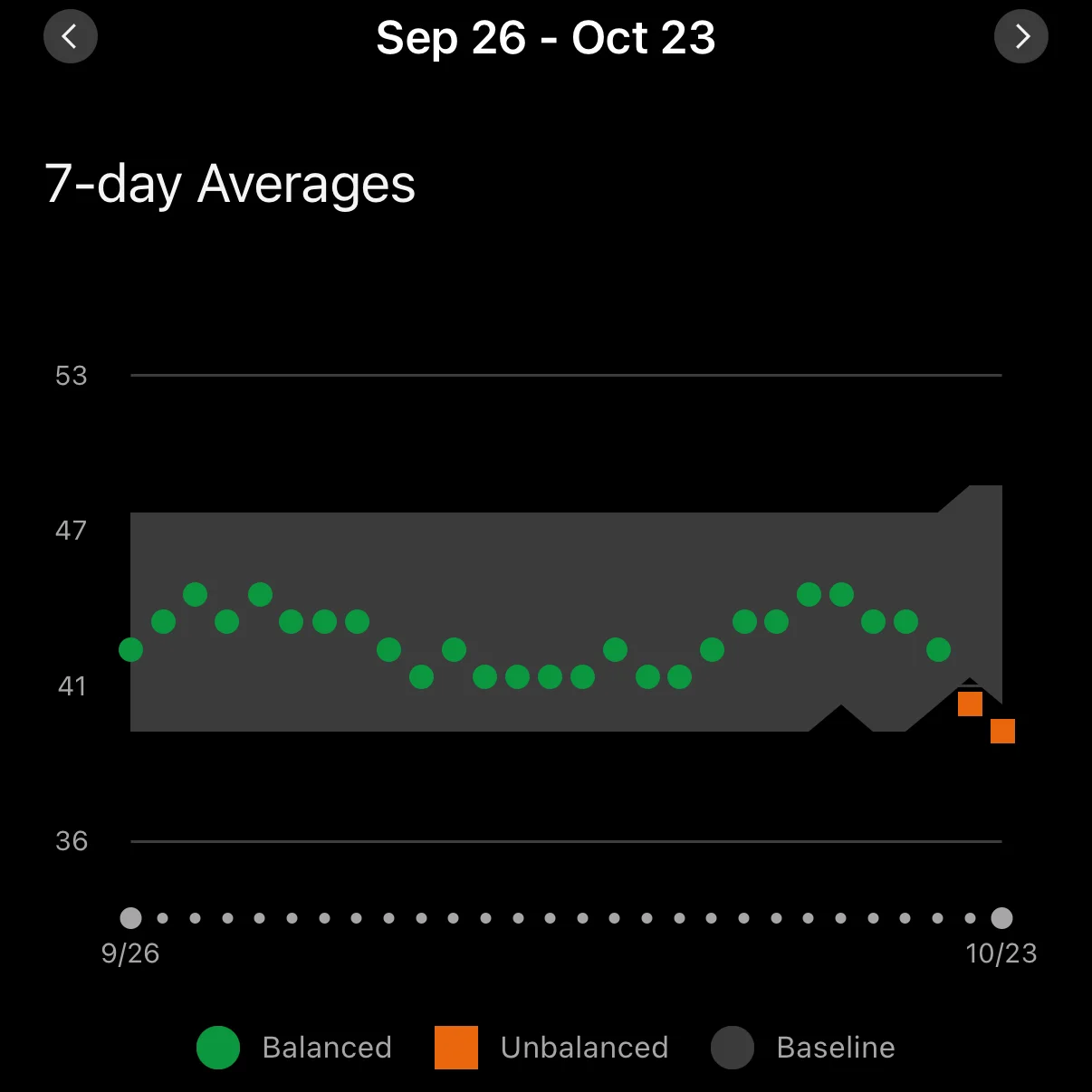
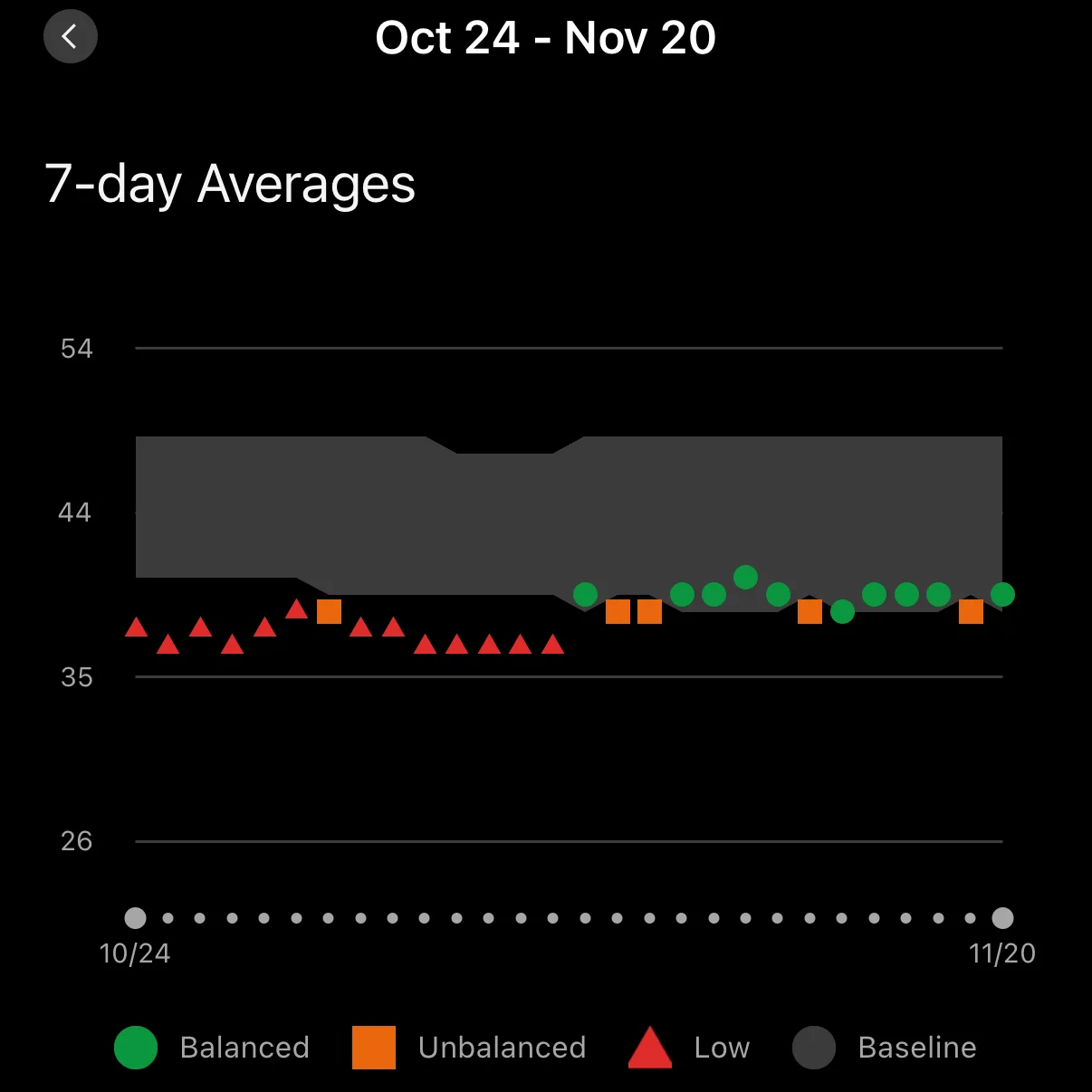
Here's the real-world example. I ran my marathon on Sunday, October 18 (a PR at 44). These are my 7-day HRV averages from my Forerunner 255.
The four weeks before the race. Balanced the entire time, bouncing around 41 to 45 ms inside my baseline. Taper, final workouts, all green. Then, right at the end, two orange squares show up. That's the race hitting.
The four weeks after. Look at all the red triangles. My HRV went Low from about October 24 to November 6, sitting around 37 to 39 ms, well below my baseline. Then it climbed back to Balanced and has stayed there, with a few orange blips. Last night's overnight average was 45 ms, which is right back to normal.
Here's what that stretch felt like:
- My sleep was rough for the whole week after the race.
- My hips were really sore for two days, but otherwise I didn't feel too bad.
- My mood was fine. We went on vacation Thursday through Sunday after the race, which definitely helped.
I took a full week off running, which was my plan going in. The second week, I did easy runs only, no workouts. By the time my HRV returned to Balanced, I felt ready to get back to real training, and the watch was a reassuring sign that my recovery was on track. It lined up with my plan almost perfectly.
The big takeaway: you can feel mostly fine while your body is still recovering. Outside of sore hips and bad sleep, I felt pretty normal. My HRV said otherwise.
One more thing worth knowing: the 7-day average lags. A few bad nights drag it down for a week, and it takes a week of good nights to pull it back up. So my body was probably bouncing back a little sooner than all those red triangles suggest.
What Lowers HRV
Anything that stresses your body can push HRV down:
- Races and hard training blocks. As my charts show, a marathon is a huge stressor. A big mileage week or a string of hard workouts can do it too.
- Alcohol. This one is very well documented. In a controlled sleep lab study, drinking before bed raised nighttime heart rate and suppressed HRV. A 2026 study of nearly 21,000 wearable users found the same thing in real life: the more people drank, the lower their HRV and the higher their resting heart rate that night. I gave up alcohol to improve my running, and I wrote about what happened.
- Bad sleep. Short or broken sleep shows up fast.
- Getting sick. HRV can drop as an illness comes on. I can't speak to that one personally. I haven't been sick in three years (but I probably just jinxed myself).
- Life stress. Work, travel, and family stress all count. Your nervous system doesn't care where the stress comes from.
How to Use HRV as a Runner
Here's how I use it: as a measurement, and as your body's way of telling you you're overdoing it.
- Watch the trend, not one night. One low night after a hard workout is normal. Don't panic.
- Several days outside your normal range? Pay attention. If your HRV is consistently below your baseline, especially along with poor sleep, fatigue, or a higher resting heart rate, swap a workout for an easy run or take a rest day. If it's above your baseline, look at the bigger picture before changing anything.
- Low status? Back off. That's your body asking for more recovery. (Here are the recovery tools that actually work.)
- After a race, use it to time your comeback. Like my marathon, it can tell you when your body is actually ready for workouts again, not just when your legs stop hurting.
- Pair it with how you feel. Heavy legs, bad sleep, or a high resting heart rate plus a low HRV trend is a clear signal. A low number when you feel great might just be a blip.
- Wear your watch to bed every night. Gaps in data make the baseline and trend less reliable.
In my Forerunner 255 review, I called HRV a helpful directional signal, not a number to obsess over. I still feel that way. If your HRV is trending down and you're about to do a hard workout anyway, that's when it's worth listening.
Does Training by HRV Actually Work?
Some coaches and studies go further: they plan hard workouts on days when HRV is normal or high, and easy runs on days when it's low.
The research is encouraging but modest:
- In most HRV-guided studies, runners ended up doing fewer hard sessions than people on a fixed plan, and still improved as much or a bit more.
- One meta-analysis found a small positive effect on VO2 max for HRV-guided training.
- The most careful review found that if HRV-guided training beats a fixed plan, it's only by a small margin. It did seem to help people avoid getting worse, though.
So HRV-guided training doesn't appear to produce dramatically better race results than a regular training plan. Its biggest value is probably helping you adjust when your body isn't responding well, so you don't pile hard work on top of a tired body. That's exactly how I use it.
How Accurate Is Your Watch?
Good enough for trends, not lab-grade. (If you're shopping, here's why Garmin dominates running watches.)
Watches measure HRV with light sensors on your wrist, not electrodes like a medical ECG. A 2025 study tested five wearables against an ECG over 536 nights. Oura rings were the most accurate, WHOOP was acceptable, and a Garmin Fenix 6 and a Polar watch were less accurate.
Keep in mind it was a small study of 13 people using specific device models, including an older Garmin. It doesn't prove every Garmin watch is inaccurate, or that the results apply to newer models.
Either way, that doesn't make your watch useless. Because Garmin compares you to your own baseline using the same sensor every night, the trend still works. Just don't sweat a 2- or 3-millisecond difference.
FAQ
What is a good HRV for a runner? There's no universal good number. HRV varies a lot by age, sex, genetics, and fitness. What matters is how your number compares to your own baseline over time.
What does "HRV Unbalanced" mean on Garmin? Your 7-day average HRV is above or below your normal baseline range. Below baseline often points to fatigue, stress, or a hard training block. A few days of it isn't a big deal, so look at how you feel and sleep before changing your plan.
What does "HRV Low" mean on Garmin? Your 7-day average is well below your baseline. It's a stronger signal that your body needs more recovery. Ease off training and prioritize sleep.
How long does HRV take to recover after a marathon? It varies. My 7-day average stayed Low for about two weeks after my marathon, then returned to Balanced. A full week off running followed by a week of easy running lined up with that recovery.
Does alcohol lower HRV? Yes. Studies consistently show that drinking in the evening raises your nighttime heart rate and lowers HRV, and more drinks means a bigger drop.
Why is my HRV lower than my friend's? HRV is very individual and naturally declines with age. Comparing it to someone else's isn't useful. Compare it to your own baseline.
How long does Garmin take to set up HRV Status? About three weeks of wearing your watch while you sleep.
Does the Forerunner 255 have Training Readiness? No. The 255 has HRV Status, but Training Readiness is on newer watches like the Forerunner 265, 570, and 970.
This article is for general information and isn't medical advice. I'm a runner, not a doctor. HRV from a watch isn't a diagnostic tool. If you have a heart condition or notice symptoms like chest pain, dizziness, or an unusually high resting heart rate, talk to a doctor.
Sources
- Garmin. Heart Rate Variability Status. Garmin owner's manuals and Garmin Health Science.
- de Zambotti M, et al. Impact of evening alcohol consumption on nocturnal autonomic and cardiovascular function in adult men and women: a dose-response laboratory investigation. Sleep, 2021.
- Real-world effects of alcohol on heart rate, sleep, and physical activity by age and sex. PLOS Digital Health, 2026.
- Hynynen E, et al. Effects of moderate and heavy endurance exercise on nocturnal HRV. International Journal of Sports Medicine, 2010.
- Düking P, et al. Monitoring and adapting endurance training on the basis of heart rate variability monitored by wearable technologies: a systematic review with meta-analysis. Journal of Science and Medicine in Sport, 2021.
- Granero-Gallegos A, González-Quílez A, Plews D, Carrasco-Poyatos M. HRV-based training for improving VO2max in endurance athletes: a systematic review with meta-analysis. International Journal of Environmental Research and Public Health, 2020.
- Manresa-Rocamora A, et al. Heart rate variability-guided training for enhancing cardiac-vagal modulation, aerobic fitness, and endurance performance: a methodological systematic review with meta-analysis. International Journal of Environmental Research and Public Health, 2021.
- Validation of nocturnal resting heart rate and heart rate variability in consumer wearables. Physiological Reports, 2025.
PR Nerd is reader-supported. This article contains affiliate links. If you purchase through them, we may earn a small commission at no additional cost to you.
Related Articles
The Run-Walk Method: When It Helps, and When It's Time to Run the Whole Way
Run-walk is one of the best ways to start running. But it isn't meant to last forever. Here's what the research says, what walk breaks really cost, and how to know when you're ready to run without them.
9 min readAmazfit: The Best Value Running Watch Americans Have Never Heard Of
Is Amazfit any good for running? Who makes it, how accurate the GPS and heart rate really are, and the 7 Amazfit watches worth buying, with Garmin and Coros alternatives.
12 min readWhat Is a Tune-Up Race? Meaning, Best Distances, and How to Use One
A tune-up race is a lower-stakes race you run before your goal race to test fitness and practice race day. Here's what tune-up means, which distances work for 10K, half, and marathon training, and how to fit one in.
8 min read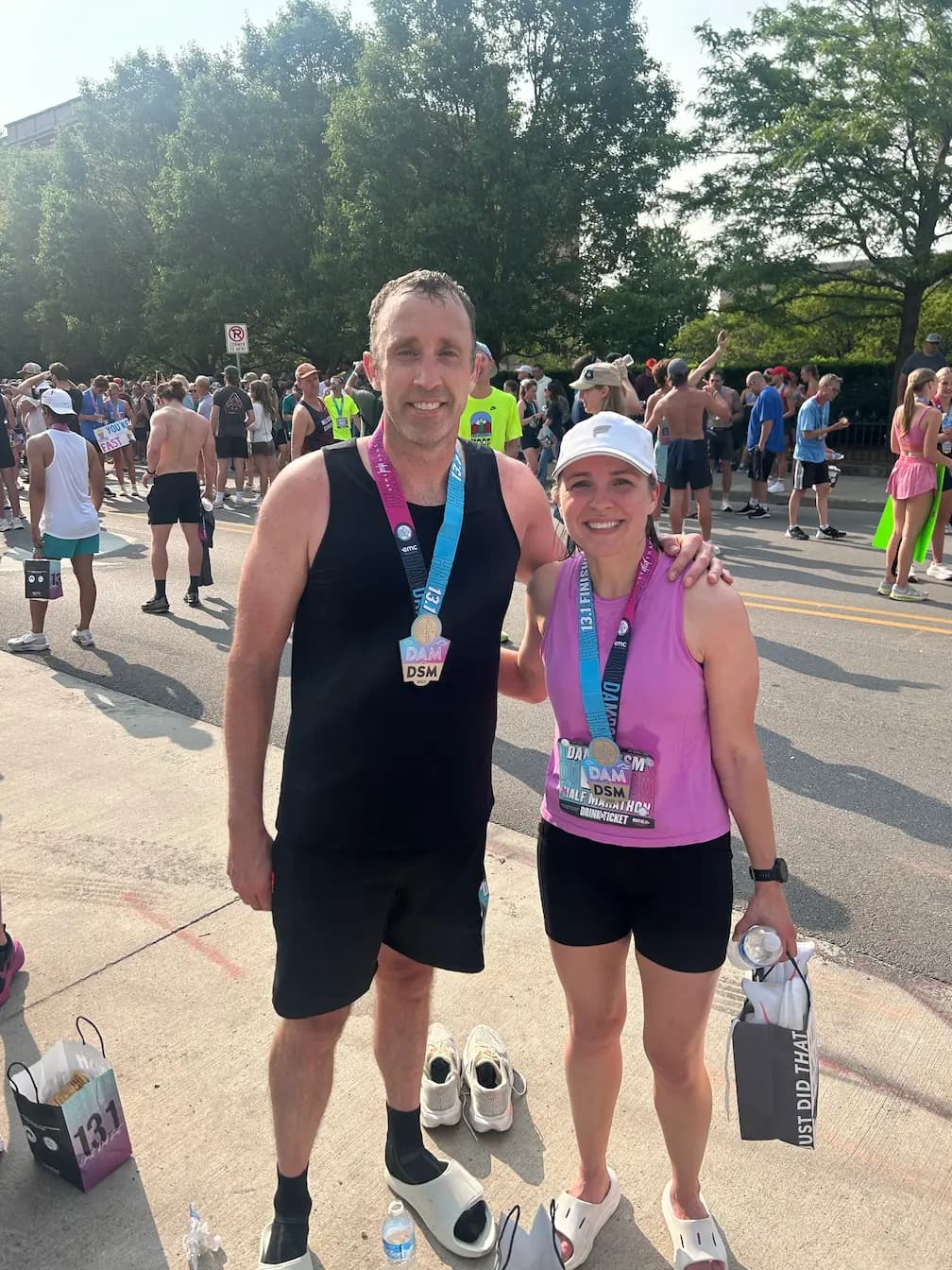
Phil Parker
Phil is a seasoned distance runner and web developer based in Iowa. He has run 15+ half marathons and 3 full marathons, and built PR Nerd because he was tired of paying for running apps that did not use real training science.
More about Phil →Follow on Strava →Comments
No comments yet. Be the first.
Leave a comment
Not published
0/1000
Ready to put this into practice?
Build your free personalized training plan based on your actual fitness — not your goal.
Build my plan →Get monthly running research, pace strategies, and fresh training articles. Zero fluff.