
Tried and Tested Low-Cost Recovery Tools for Distance Runners
Skip the $500 vibration plates and sauna blankets. These 5 cheap, durable recovery tools under $80 are the ones that actually stay in a runner's daily rotation.
Scroll any fitness feed and you'll get sold $500 vibration plates, thousand-dollar sauna blankets, and red-light panels that glow like a spaceship cockpit. They make great content. For most distance runners, they're expensive distractions.
Real recovery isn't complicated. Sleep, eat enough, and use a few simple tools that target the muscles and tendons running actually beats up. That's it.
I've tried a lot of recovery gear over the years. Most of it ends up in a closet. A handful of tools earned a permanent spot in my routine, and every one of them costs less than a pair of race-day shoes.
Here are the five I actually use, what the research says about them, and how to get the most out of each.
What's In This Guide
1. Percussion Massage Gun
The Pick: Sharper Image Powerboost Deep Tissue Percussion Massage Gun

A massage gun is the fastest way to take the edge off sore quads, calves, and glutes after a long run or a hard workout block. And you don't need a $400 name brand to get one that hits hard enough to matter.
I've had the Sharper Image Powerboost for almost three years and it still runs like the day I bought it. The battery lasts forever, the speed settings cover everything from gentle to aggressive, and the attachments are genuinely useful: the bullet head digs into glutes, and the node head is great on calves.
- The science: Percussion floods the area with sensory input, which calms the nervous system's "protect this muscle" response and temporarily reduces tension. It doesn't break up scar tissue (that's marketing), but studies consistently show it reduces perceived soreness and can improve short-term range of motion.
- How to use it: 60–90 seconds per muscle group. Use it before a run to loosen up or after to calm things down. Keep it off bony spots like your shins and hip bones.
2. The Dual Foam Roller Strategy
Foam rolling is the foundation of any self-massage routine. But one roller rarely handles every job, which is why I keep two. A roller that feels right on tender quads barely registers on a dense upper back.
Option A: The Premium Pick
The Pick: TriggerPoint Grid 2.0 Foam Roller (26-Inch) (~$79)
The Grid has a hollow core wrapped in textured, multi-density foam that feels closer to a therapist's hands than a smooth cylinder. The 26-inch length keeps you stable when rolling your back or both quads at once. It's rated to 500 pounds and doesn't go soft over time. The only real knock is the price.
Option B: The Budget Pick
The Pick: Amazon Basics High Density Foam Roller (24-Inch) (~$22)
If $80 for foam feels steep, this one does most of the job for about a quarter of the price. It's solid, rigid, and basically indestructible. At 24 inches, it's long enough for most runners and still easy to store.
- My take: I use both every week. The TriggerPoint has just enough give for beat-up quads after a workout. The Amazon Basics roller is harder and less forgiving, which is exactly what I want for my upper back and glutes.
3. The Humble Lacrosse Ball
The Pick: Beskar Massage Lacrosse Ball (~$8)

If I could keep only one tool on this list, it's this $8 ball. A foam roller is too wide to find the small, stubborn spots. A lacrosse ball goes exactly where you put it.
I roll the arches of my feet on it almost every day. High mileage hammers the plantar fascia, and two minutes under my desk keeps my feet loose and heel pain away. It's also the best tool I've found for glutes, piriformis, and the knots between your shoulder blades. Lean against a wall, find the spot, and hold.
- The science: Sustained pressure on a tender spot reduces pain sensitivity and muscle guarding in that area. Research on self-massage for plantar heel pain is encouraging, and it's about the cheapest intervention you'll ever try.
4. Wooden Slant Board
The Pick: Norse Portable Wooden Slant Board (~$29)
Most runners stretch their calves against a wall, and that's fine for the gastrocnemius, the big muscle you can see. But the soleus underneath it does a huge share of the work in running, and it's easy to shortchange.
A slant board sets your foot at a fixed, repeatable angle, so every stretch is the same stretch. Stand on it with straight knees for your gastrocs, bend your knees slightly to shift the load to your soleus, and use the edge for heel drops.
- The science: Heavy, slow calf loading, including eccentric heel drops, is one of the best-supported approaches for managing Achilles tendinopathy and a staple of plantar fasciitis rehab. A slant board makes both the stretching and the loading easy to do consistently.
- My take: I lean on my slant board hard during marathon buildups. Having a stable, non-slip board sitting in the living room means I actually do the work instead of skipping it.
5. Multi-Loop Stretching Strap
The Pick: Multi-Loop Static Stretching Strap (~$10)
If you stretch your hamstrings by reaching for your toes and straining your lower back, you're mostly stretching your patience. A non-elastic strap with sewn-in loops gives you leverage, so you can relax into the stretch instead of fighting for it.
- The science: Lying on your back with a strap lets you isolate hamstrings, hips, and groin without other muscles tensing up to hold the position. It also makes PNF-style "contract-relax" stretching easy: press into the strap for a few seconds, relax, then ease a little deeper.
- My take: It's a $10 piece of nylon, but the loops let you track progress. If you're reaching one loop farther than you were a month ago, you know it's working.
| Tool | Best For | Price Point |
|---|---|---|
| Percussion Gun | Sore quads, calves & glutes | ~$40 - $70 |
| Foam Roller | Broad, multi-muscle rolling | ~$22 - $79 |
| Lacrosse Ball | Foot arches, glutes & upper back | ~$8 |
| Slant Board | Calf, soleus & Achilles work | ~$29 |
| Stretching Strap | Hamstring & hip mobility | ~$10 |
The Bottom Line
Consistency beats gadgets every time. A $29 slant board and an $8 lacrosse ball used three times a week will do more for your running than a $500 device collecting dust in the basement.
Coming back from a hard race or an overuse injury? Read our guide to returning to training safely. Ready to plan your next block? Build a free schedule with real workout paces in our Training Plan Generator.
PR Nerd is reader-supported. This article contains affiliate links. If you purchase through them, we may earn a small commission at no additional cost to you.
Related Articles
The Comeback: Post-Race Recovery and Getting Back to Running Safely
Part 4 of our Race Prep Series: what to eat and do in the hours after crossing the finish line, how long to actually stay off running, DOMS, massage, and a research-backed timeline for getting back into training.
10 min readThe Best Recovery Footwear for Runners (Your Feet Will Thank You)
You spent good money on running shoes. What you wear the other 22 hours of the day matters just as much. Here is what recovery footwear actually does and the best options for runners.
4 min readOvercoming Plantar Fasciitis: What Ten Years with a Stubborn Injury Taught Me About True Relief
A decade of plantar fasciitis taught me that lasting relief isn't about icing and inserts. Here is the mobility and strengthening routine that finally got me pain-free after ten years.
7 min read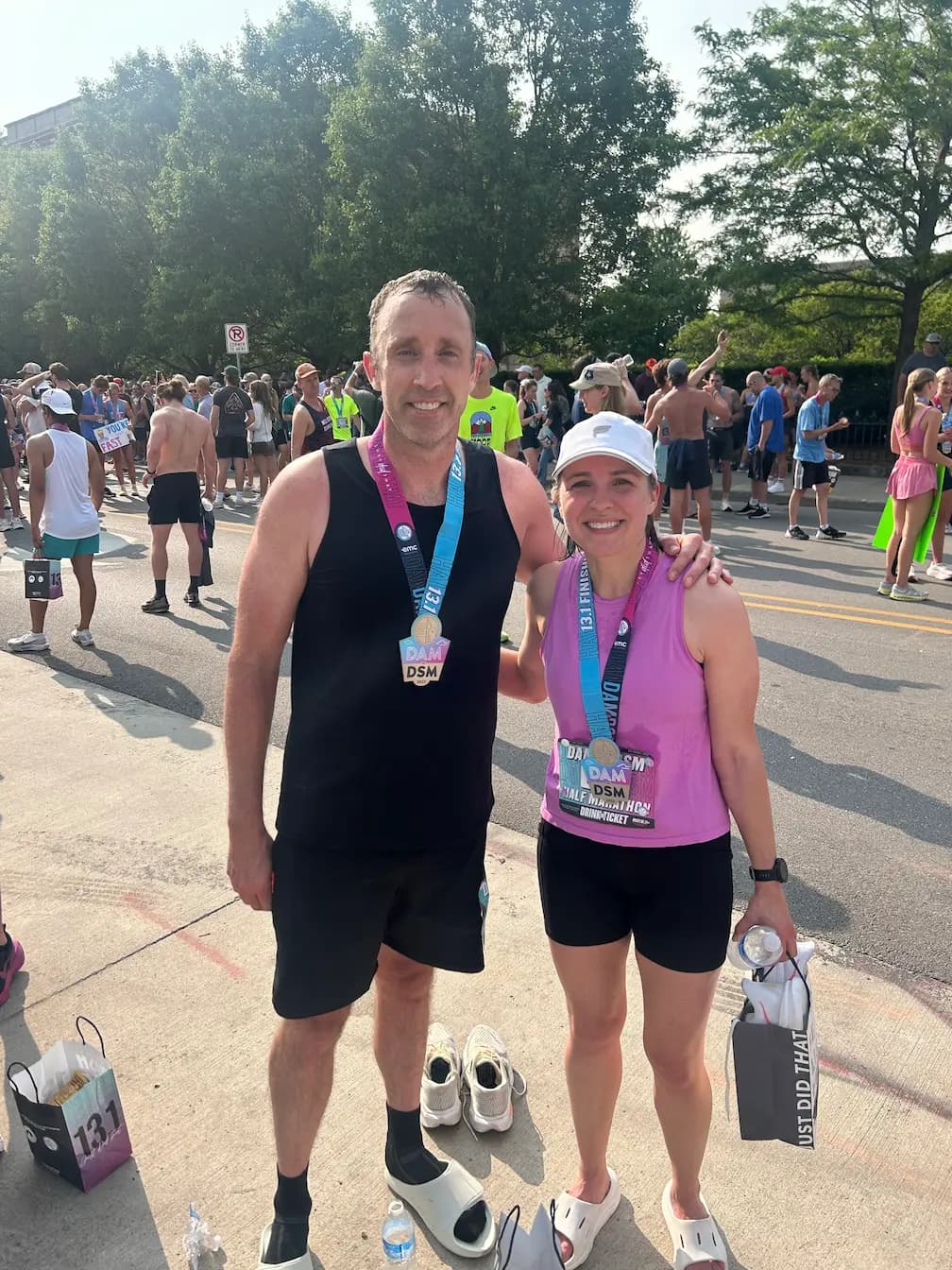
Phil Parker
Phil is a seasoned distance runner and web developer based in Iowa. He has run 15+ half marathons and 3 full marathons, and built PR Nerd because he was tired of paying for running apps that did not use real training science.
More about Phil →Follow on Strava →Comments
No comments yet. Be the first.
Leave a comment
Not published
0/1000
Ready to put this into practice?
Build your free personalized training plan based on your actual fitness — not your goal.
Build my plan →Get monthly running research, pace strategies, and fresh training articles. Zero fluff.