

Amazfit: The Best Value Running Watch Americans Have Never Heard Of
Is Amazfit any good for running? Who makes it, how accurate the GPS and heart rate really are, and the 7 Amazfit watches worth buying, with Garmin and Coros alternatives.
I don't know a single person who wears an Amazfit watch. Not at my running club, not at races, not in my family. Here in the US, it's Garmin, Apple, and lately Coros.
But Amazfit pages are some of the most-visited on this site. People are clearly searching for them, and once I started digging, I understood why. Amazfit makes some of the best-value running watches you can buy. Most Americans just haven't heard of them yet.
I'm not buying one myself (I'm switching to Coros in January), so this guide is built from the specs and from independent testers who have put these watches through real runs. Here's who Amazfit is, how accurate their watches really are, and the seven worth considering.
What's In This Guide
Who Is Amazfit?
Amazfit is made by Zepp Health, and the company has been around much longer than most people realize.
It started in 2013 in China under the name Huami. Huami first made its name building the Xiaomi Mi Band, one of the best-selling fitness trackers in the world. In other words, before most of us had heard of Amazfit, they were already making millions of wearables for someone else.
Huami launched Amazfit as its own brand in 2015, listed on the New York Stock Exchange in 2018, and renamed itself Zepp Health in 2021. It still trades on the NYSE today under the ticker ZEPP.
Why haven't Americans heard of them? The numbers back up what I see at races. In 2025, Zepp Health reported about $259 million in revenue. Europe brought in about $110 million and Asia-Pacific about $91 million, while the US brought in about $44 million, roughly 17% of the total. Amazfit is a big name in Europe and Asia and still a small one here.
That's starting to change, and fast. Zepp's 2025 revenue of $258.9 million was up about 42% from 2024, and all of it came from Amazfit, whose sales grew about 51% for the year. Zepp also says third-party data now ranks Amazfit among the top six smartwatch brands in the US by sales value. It has also signed big-name runners, including Olympic medalist Josh Kerr.
About the China question: Some readers will want to know where their data goes. Amazfit was founded in China and still has major operations there, though Zepp Health is a US-listed public company. If that matters to you, read Zepp's privacy policy before you buy, the same way you would with any wearable that tracks your health and location.
Quick Picks
- Best for new runners: Amazfit Active 3 Premium
- Best under $100: Amazfit Active 2
- Best battery for the money: Amazfit Active Max
- Cheapest watch that still works for running: Amazfit Bip 6
- Best everyday smartwatch that can also train: Amazfit Balance 2
- Best rugged watch: Amazfit T-Rex 3
- Best for serious runners: Amazfit Cheetah 2 Pro
The Lineup at a Glance
| Watch | List price | GPS | GPS battery | Offline maps | Water rating | Amazon rating |
|---|---|---|---|---|---|---|
| Bip 6 | $79.99 | Single-band | Up to 32 hours | ✓ | 5 ATM | 4.3 |
| Active 2 | $99.99 ($129.99 Premium) | Single-band | Up to 21 hours | ✓ | 5 ATM | 4.4 |
| Active 3 Premium | $169.99 | Single-band | Up to 24 hours | ✓ | 5 ATM | 4.6 |
| Active Max | $169.99 | Single-band | Up to 64 hours | ✓ | 5 ATM | 4.6 |
| Balance 2 | $299.99 | Dual-band | Up to 33 hours | ✓ | 10 ATM | 4.4 |
| T-Rex 3 | $279.99 | Dual-band | Up to 42 hours | ✓ | 10 ATM | 4.4 |
| Cheetah 2 Pro | $449.99 | Dual-band | Up to 31 hours | ✓ | 5 ATM | 4.5 |
Amazon ratings are from when each watch was added to our Watch Finder. Prices are list prices at the time of writing, and Amazfit runs frequent sales. Battery numbers are Amazfit's claims; real-world GPS battery is usually lower.
Notice the offline maps column. Every one of these watches has offline maps, including the $80 Bip 6. Garmin doesn't put maps on a Forerunner until you get to the high end.
And here's how each one lines up with the Garmin and Coros watches most runners compare them to:
| Amazfit | Price | Closest Garmin | Closest Coros |
|---|---|---|---|
| Bip 6 | $79.99 | Instinct E ($199) | — |
| Active 2 | $99.99 | Forerunner 55 ($199) | — |
| Active 3 Premium | $169.99 | Forerunner 70 ($249) | Pace 4 ($249) |
| Active Max | $169.99 | Forerunner 70 ($249) | Pace 4 ($249) |
| Balance 2 | $299.99 | Vivoactive 6 ($299) | — |
| T-Rex 3 | $279.99 | Instinct 3 ($399) | Nomad ($349) |
| Cheetah 2 Pro | $449.99 | Forerunner 265 ($449) | Pace 4 Pro ($449) |
Garmin and Coros prices are list prices from our Watch Finder.
In almost every row, Amazfit is cheaper, often by a lot, and usually has more hardware: brighter screens, maps, a speaker and mic. The question is whether the data is as good. That's next.
How Accurate Is Amazfit?
This is the part that matters for runners. A watch that's cheap but wrong isn't a deal.
I read through a lot of independent testing, and a pretty consistent picture comes out of it.
GPS: it depends on the model
The cheaper Amazfits (Bip 6, Active 2, Active 3 Premium, Active Max) use single-band GPS. That's the same general category of GPS found in many entry-level running watches, including the Garmin Forerunner 55 and 70. It's fine most of the time, but it can drift around tall buildings and trees.
- On the Active 3 Premium, Wareable found distance occasionally drifted and average pace was sometimes off compared with a dual-band watch, but run tracking was reliable on most runs. Gadgets & Wearables ran it next to a Garmin Forerunner and got nearly identical results: 5.50 km vs 5.52 km.
- On the Bip 6, Wareable found it underreported distance by a noticeable amount next to a dual-band watch, and the GPS track sometimes wandered off course even in good conditions. It's still usable, but it's the least accurate of the bunch.
The pricier Amazfits (Balance 2, T-Rex 3, Cheetah 2 Pro) use dual-band GPS, which is a real step up. the5krunner called the T-Rex 3's GPS excellent. One caveat: in the5krunner's standardized 10-mile GPS test, the Cheetah 2 Pro scored 73%, which they called middle of the pack, behind the best dual-band watches from Garmin and Coros.
Heart rate: good on easy runs, weaker on hard ones
This is Amazfit's weak spot, and it's the same story across almost every review:
- Steady runs are good. On an easy run, Gadgets & Wearables had the Active 3 Premium and a Garmin both averaging 135 bpm.
- Intervals are where it struggles. The optical sensor has trouble keeping up with fast spikes. On the Active Max, the5krunner found some workouts matched a reference strap within 1%, while others were off by up to 10% because it underreported heart rate during hard efforts.
- The newest high-end models are better, though results vary by tester. Some reviewers found the Cheetah 2 Pro's heart rate matched a chest strap closely, while others saw more discrepancies on hard efforts. the5krunner found the Cheetah 2 Ultra's heart rate consistently excellent.
The good news: there's an easy fix if you need it. If you rely on heart rate for structured interval training, consider pairing a chest strap. Wrist-based sensors can struggle with rapid changes in intensity, and Amazfit is no exception. Amazfit watches pair with Bluetooth chest straps, and reviewers confirmed Garmin and Polar straps work. (This is true of every wrist-based watch, to be fair. I dug into that in how accurate is your watch's heart rate.)
Training metrics: real, but less polished
Amazfit watches give you most of what Garmin does: VO2 max, training load, recovery time, a readiness score, lactate threshold, and even running dynamics like ground contact time. In one side-by-side test, the Active 3 Premium's lactate threshold estimate landed within about 1 bpm of a Garmin's.
The difference is polish. Reviewers keep saying the training analysis and the Zepp app need refinement. Garmin has been doing this for 20 years, and it shows.
The bottom line on accuracy
| Easy runs | Intervals | Who it's accurate enough for | |
|---|---|---|---|
| Single-band models (Bip 6, Active 2, Active 3 Premium, Active Max) | Good | Heart rate can lag or read low | New and casual runners |
| Dual-band models (Balance 2, T-Rex 3, Cheetah 2 Pro) | Very good GPS, good heart rate | Consider a chest strap if you train by heart rate | Most runners, including people training for races |
For someone getting into running, that's plenty. If you're chasing a BQ and live by your heart rate zones on interval day, consider a chest strap, or spend the money on a Garmin or Coros.
The 7 Amazfit Watches Worth Buying
1. Amazfit Bip 6: the $80 starter watch
The Bip 6 is about as cheap as a real GPS running watch gets. You get a bright AMOLED screen, offline maps, a speaker and mic, and around two weeks of battery for less than a pair of running shoes.
The catch: its GPS is the weakest in the lineup. It's fine for logging your runs and seeing your progress, but don't expect perfect pace and distance.
Garmin alternative: the Instinct E costs over twice as much and has no touchscreen or maps, but it's tougher and has Garmin's training features. Compare them in Bip 6 vs Instinct E.

Amazfit Bip 6
An unbelievable amount of watch for well under $100.
2. Amazfit Active 2: the best watch under $100
The Active 2 looks like a real watch instead of a fitness band, and it adds a round AMOLED screen and better build quality over the Bip 6. The Premium version ($129.99) adds a sapphire lens and a leather strap.
Who it's for: the Active 2 is the middle ground. It's for someone who wants a traditional round watch, a nicer everyday look than the Bip 6, and basic running features without spending much. It's not as runner-focused as the Active 3 Premium, but it's a solid entry point if running is only one part of your fitness routine.
Garmin alternative: the Forerunner 55 is about $100 more and has a duller screen and no maps, but more mature training features. Also see Active 2 vs Vivoactive 5 and Active 2 vs Active 3 Premium.

Amazfit Active 2
A $129 GPS watch with an AMOLED display, offline maps, and a 5 ATM build.
3. Amazfit Active 3 Premium: the best Amazfit for new runners
This is the one I'd point most new runners to. Amazfit built it specifically for beginner and intermediate runners, and it shows. It has four physical buttons (much easier mid-run than swiping), a 3,000-nit screen, sapphire glass, offline maps, and built-in workouts with pace guidance.
Wareable pointed out that Garmin and Coros usually save sapphire glass for their pricier flagships. Here it's on a $170 watch.
The catch: single-band GPS, heart rate that struggles on intervals, and battery that falls short of the claim when you use the most accurate GPS mode.
Garmin and Coros alternatives: the Forerunner 70 and Coros Pace 4 both cost about $80 more. The Pace 4 has dual-band GPS, and the Garmin has better training analysis. See Active 3 Premium vs Forerunner 70.

Amazfit Active 3 Premium
Offline routable maps and real running tools, at a shockingly low price.
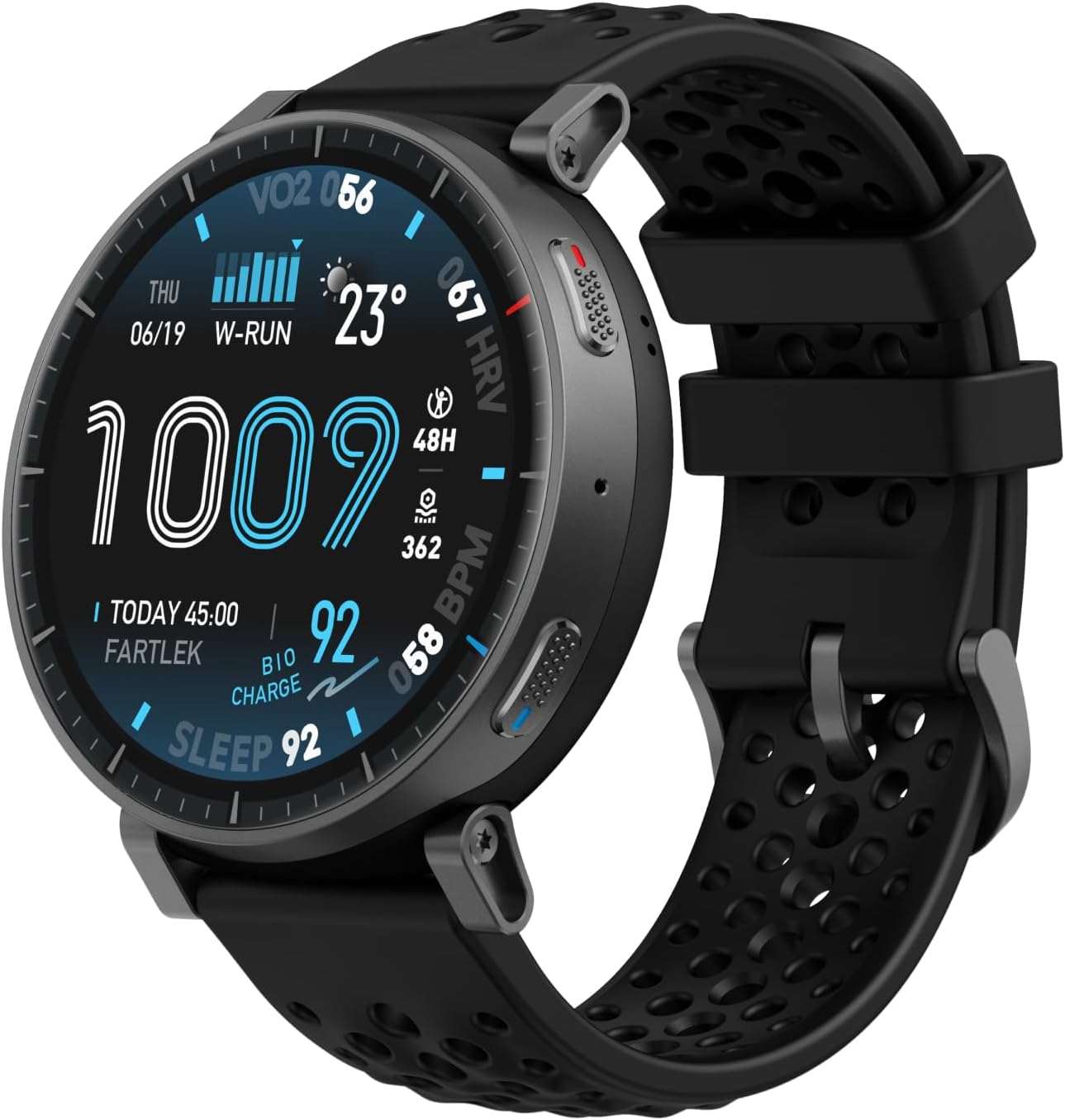
4. Amazfit Active Max: the battery monster
Same price as the Active 3 Premium, but a bigger watch with a bigger 1.5-inch screen and a huge battery: Amazfit claims up to 25 days of normal use and up to 64 hours of GPS. Testers got less than that (the5krunner estimated closer to 40 hours of GPS), but that's still remarkable at $170.
Who it's for: runners who hate charging, people with bigger wrists, and anyone who wants the biggest screen for the money.
Garmin alternative: see Active Max vs Forerunner 55 and Active Max vs Forerunner 70.
Amazfit Active Max
A bright, long-lasting all-rounder for under $200.
5. Amazfit Balance 2: the everyday smartwatch that can train
The Balance 2 is Amazfit's answer to a Garmin Venu or Apple Watch: an all-day smartwatch with a sleek look. But it also has dual-band GPS and 10 ATM water resistance, which makes it a better running watch than its looks suggest.
Who it's for: someone who wants one watch for work, the gym, and running, with better GPS than the Active models.
Garmin alternative: the Vivoactive 6 is the same price but has single-band GPS and no maps. The Venu 3 is $150 more. See Balance 2 vs Venu 3.

Amazfit Balance 2
Amazfit's daily-driver smartwatch, with genuine training tools underneath.
6. Amazfit T-Rex 3: the rugged one
The T-Rex 3 is built like a tank, with military-standard durability testing, 10 ATM water resistance, and dual-band GPS that the5krunner called excellent. Their review put it well: for nearly every criticism, the answer is "yes, but it only costs $279."
The catch: it's big and heavy (68 grams), and the heart rate sensor isn't as reliable as the GPS.
Garmin and Coros alternatives: the Instinct 3 costs $120 more and has no maps. The Coros Nomad is another rugged option. See T-Rex 3 vs Instinct 3.

Amazfit T-Rex 3
A military-grade rugged AMOLED watch that undercuts Garmin and Suunto's outdoor flagships by hundreds of dollars.
7. Amazfit Cheetah 2 Pro: the serious running watch
This is Amazfit's real attempt at a Garmin Forerunner. It launched in April 2026 for $449.99 with a Grade 5 titanium case, sapphire glass, dual-band GPS, offline maps, a flashlight, and 32GB of storage, at the same price as a Forerunner 265 and less than a 570.
The catch: you're paying Garmin-level money, which makes Amazfit's weaknesses matter more. Its GPS tested middle of the pack, and heart rate on hard intervals has been mixed in testing, so you may want a chest strap if you train by heart rate. At this price, I'd lean toward a Garmin or Coros unless the titanium build and maps really matter to you.
Garmin and Coros alternatives: the Forerunner 265 (often on sale for much less right now) and the Coros Pace 4 Pro. See Cheetah 2 Pro vs Forerunner 265, Cheetah 2 Pro vs Coros Apex 4, and Cheetah 2 Pro vs Forerunner 970.

Amazfit Cheetah 2 Pro
Amazfit's first truly serious dedicated running watch.
Amazfit also makes premium versions of several of these (Balance 3, T-Rex 3 Pro, Cheetah 2 Ultra, and others). For most runners, the seven above cover everything you need.
Active 3 Premium vs Active Max
This is the most common Amazfit question, and it makes sense: they're the same price and share a lot of the same insides.
| Active 3 Premium | Active Max | |
|---|---|---|
| List price | $169.99 | $169.99 |
| Screen | 1.32" AMOLED, 3,000 nits | 1.5" AMOLED, 3,000 nits |
| Lens | Sapphire | Strengthened glass |
| Case | 45mm, stainless steel frame | 48mm, aluminum frame |
| Battery (typical use) | Up to 12 days | Up to 25 days |
| GPS battery | Up to 24 hours | Up to 64 hours |
| GPS | Single-band | Single-band |
Pick the Active 3 Premium if you want a smaller, tougher, nicer-looking watch with four buttons that are easy to use mid-run. Pick the Active Max if you want the bigger screen and twice the battery life. Accuracy should be about the same, since both use single-band GPS and similar heart rate sensors.
More detail in our full Active 3 Premium vs Active Max comparison.
What You Give Up vs Garmin
Amazfit's prices are amazing, but you do give some things up:
- No offline Spotify. You can load your own music files and control Spotify on your phone, but you can't download Spotify playlists to the watch. For a lot of runners, that's a dealbreaker. It's one of the main reasons runners stick with Garmin. (More in Forerunner 570 vs 970.)
- Less mature training analysis. The numbers are there, but Garmin's recovery and training guidance is more refined.
- Heart rate on hard efforts. Consider a chest strap if your intervals depend on heart rate.
- A smaller community. Garmin Connect is where most runners' friends, clubs, and coaches already are. Amazfit does sync with Strava, TrainingPeaks, and Runna, which covers most of what runners need.
What you don't give up: you don't need a subscription. Zepp's core training metrics, maps, workout features, and Zepp Coach training plans are all included for free. The only paid add-on is an optional sleep-coaching service. That's a real advantage at a time when Garmin is putting some newer features behind its paid Connect+ tier.
Who Should Buy an Amazfit?
Amazfit is a great choice if:
- You're new to running and on a tight budget. An Active 3 Premium or Active 2 gives you everything you need to start, for less than most running shoes. (Just starting out? Read what to expect when you start running.)
- You want maps, a bright screen, and long battery without paying Garmin prices.
- You mostly run easy and steady, or you're willing to add a chest strap for intervals.
Look at Garmin or Coros instead if:
- Offline Spotify is a must.
- You're training seriously and rely on precise heart rate and training-load guidance.
- You want the bigger running community and ecosystem.
Still deciding? The Watch Finder matches you to a watch in four questions. Or compare budget options in Forerunner 170 vs 265 vs Coros Pace 4, see the best running watches of 2026, and read the running watch buying guide.
FAQ
Is Amazfit a good brand? Yes. Amazfit is made by Zepp Health, which has been building wearables since 2013, including Xiaomi's Mi Band. Their watches are well built and very good value, though their software is less polished than Garmin's.
Who makes Amazfit? Zepp Health, formerly Huami. It was founded in China in 2013 and is listed on the New York Stock Exchange as ZEPP.
Is Amazfit accurate for running? For most runners, yes. The dual-band models (Balance 2, T-Rex 3, Cheetah 2 Pro) have very good GPS. The cheaper single-band models are fine for most runs but can drift. Heart rate is good on steady runs and less reliable during intervals. If you train by heart rate, a chest strap helps.
Is Amazfit better than Garmin for the money? For hardware, Amazfit often wins. You get brighter screens, sapphire glass, offline maps, and longer battery life at prices where Garmin offers more basic hardware. Garmin still wins on training analysis, ecosystem, and the maturity of its running features. If value matters more than brand loyalty, Amazfit deserves a serious look.
Is Amazfit as good as Garmin? Not quite, especially for training analysis and heart rate on hard efforts. But it's much cheaper, and it often has better hardware for the price, like brighter screens, sapphire glass, and offline maps.
What is the best Amazfit watch for running? For new runners, the Active 3 Premium. For serious runners, the Cheetah 2 Pro. For the best battery on a budget, the Active Max.
Does Amazfit need a subscription? No. The Zepp app, your data, software updates, maps, and Zepp Coach training plans are free. Only an optional sleep-coaching service costs extra.
Does Amazfit work with Strava? Yes. Amazfit syncs with Strava, plus TrainingPeaks, Runna, Apple Health, and others.
Can Amazfit play Spotify offline? No. You can control Spotify on your phone and load your own music files to most models, but you can't download Spotify playlists to the watch.
Can I use a chest strap with Amazfit? Yes. Amazfit watches pair with Bluetooth heart rate straps, including Garmin and Polar straps.
Why is Amazfit so cheap? One likely reason is experience: Zepp Health spent years building fitness trackers in huge volumes for Xiaomi. Its watches also have less polished software than Garmin's, which is part of what you're not paying for.
Prices are list prices at the time of writing and change often, especially around Black Friday.
PR Nerd is reader-supported. This article contains affiliate links. If you purchase through them, we may earn a small commission at no additional cost to you.
Sources
- Zepp Health investor relations: company history and milestones.
- Zepp Health fourth quarter and full year 2025 and first quarter 2026 financial results and earnings calls (revenue by region, North American growth, US market share).
- Notebookcheck, Huami officially changes its name to Zepp Health.
- Amazfit US product pages and Zepp app store listing (prices, specifications, subscriptions).
- Wareable, Amazfit Active 3 Premium review and Amazfit Bip 6 review.
- Gadgets & Wearables, Amazfit Active 3 Premium review and Amazfit Active Max review.
- the5krunner, Amazfit T-Rex 3 review, Amazfit Active Max specifications, Amazfit Cheetah 2 Pro specifications, and Amazfit Cheetah 2 Ultra review.
- Android Authority, Amazfit Cheetah 2 Pro launch.
Related Articles
How Accurate Is Your Watch's Heart Rate? Garmin, Coros, Polar, and Apple Explained
Your watch's heart rate isn't magic, and it isn't always right. Here's how wrist heart rate actually works on Garmin, Coros, Polar, and Apple, what throws it off, and when a chest strap or armband is worth it.
9 min readGround Contact Time: What's a Good Number, and Does It Matter?
What ground contact time means on your Garmin, what's a good GCT, why pace changes it so much, and whether you should try to lower it, with real data from my own runs.
8 min readHow to Pick the Right Running Watch (Without Paying for Features You Will Never Use)
Running watches range from $99 to over $1,000, and the marketing makes it worse. Here is what GPS accuracy, VO2 max tracking, AMOLED displays, and battery life actually mean, and how to figure out which features you will actually use.
9 min read
Phil Parker
Phil is a seasoned distance runner and web developer based in Iowa. He has run 15+ half marathons and 3 full marathons, and built PR Nerd because he was tired of paying for running apps that did not use real training science.
More about Phil →Follow on Strava →Comments
No comments yet. Be the first.
Leave a comment
Not published
0/1000
Ready to put this into practice?
Build your free personalized training plan based on your actual fitness — not your goal.
Build my plan →Get monthly running research, pace strategies, and fresh training articles. Zero fluff.