

What Running a Marathon Actually Costs You
The entry fee is the cheap part. Here is what a marathon actually demands from your time, your body, your nutrition, and your family before you ever reach the start line.
Nobody warned me about the toenails.
I have run two marathons, Grandma's Marathon in Duluth in 2012 and the IMT Des Moines Marathon in 2018. I am currently training for number three. I also failed in marathon training in 2010 that led to an injury. In the sixteen years since I first attempted a marathon training block, I have learned things about this distance that nobody puts in the race brochure.
This is that article.
It Feels Like a Part Time Job
A proper marathon training block is 18 to 20 weeks long. During that time you will run four to six days per week. Your Saturday mornings belong to the long run. Not some of your Saturday mornings. All of them.
Week 1 your long run might be 12 miles. By week 13 or 14 you are looking at 20 to 22 miles. That is three to four hours of running before the rest of your family has finished their first cup of coffee.
Add in the midweek runs, the tempo sessions, the recovery miles, the stretching, the foam rolling, and the general obsessing over your training log and you are looking at 8 to 12 hours per week dedicated to this goal.
Your family may not always understand this. They might not have compassion for why you are exhausted on Sunday afternoon or why you cannot stay out late on Friday before a 20 miler. That is okay. This is for you. Own it, communicate it, but do not apologize for it.
Your Body Will Do Strange Things
In 2010 I attempted my first marathon training block and made a mistake that ended it before race day. I ran every training run at my goal race pace, which was around 8:00 per mile. I thought that was how training worked. I got up to 20 miles and my body simply stopped cooperating. Tendinitis. Season over.
The lesson I learned the hard way is that most of your training miles should feel almost embarrassingly slow. Easy runs exist to build your aerobic base without destroying your legs. When I finally followed a proper training plan with calibrated easy paces, everything changed. If your easy pace feels too slow, it is probably exactly right. Don't worry about what some try-hard posted on Strava for their pace, worry about your pace and staying healthy. We broke down how training paces actually work in how to run your first sub 2 hour half marathon.
Beyond pacing, here is what else nobody tells you:
You will lose toenails. It happens to most marathon runners eventually. Buy your running shoes half a size larger than your street shoes to give your feet room to swell over long distances. This is not optional advice.
Your legs will never feel completely fresh during peak training weeks. Accumulated fatigue is part of the process. Week 14 feels nothing like week 1. Trust the taper when it comes.
Be prepared to train in every weather condition imaginable. On race day you get whatever the weather decides to give you. You might get blistering heat, freezing cold, rain, or thick humidity on race day. That's just the luck of the draw. If you only trained in perfect conditions you will be in for a shock. Get comfortable running in miserable weather before race day.
Rotate your shoes and replace them on schedule. Running shoes break down around 300 to 500 miles. If you try to squeeze extra miles out of worn out shoes during a marathon training block you are asking for soreness or injury. Budget for at least two pairs. We broke down the different types of running shoes and what to look for in our running shoe guide.
The Nutritional Toll Is Real
Your body burns through an enormous amount of fuel during marathon training. During peak weeks you are running 40 to 50 miles and your caloric needs go up significantly.
You will want to eat everything in sight. I mean everything. Make sure you have healthy options available or you will find yourself eating ice cream multiple times a day just to keep up with the caloric demand. There is nothing wrong with ice cream but your nutrition quality matters during a training block.
Hydration is not optional. Neither are electrolytes. Especially in summer training when you are sweating through long runs in the heat. I drink LMNT daily to ensure I have the electrolytes I need. Proper electrolyte replacement is the difference between finishing a long run feeling okay and finishing it feeling destroyed.
Fueling during long runs is a skill you have to practice. In 2018 at the Des Moines Marathon I did not fuel properly during the race. I nearly fell apart in the final miles and had to gut out the finish. I ran 3:52 that day and I am convinced I left time on the course because of poor fueling decisions. Do not make that mistake. Practice your race day fueling strategy on every long run over 14 miles. We covered exactly how to do this in how to fuel long runs and races without bonking.
If It Is Your First Marathon, Let Go of the Clock
I finished Grandma's Marathon in 3:56. I did not negative split it, I did not execute a perfect race plan, and I did not hit some arbitrary time goal. I finished. And crossing that finish line in Duluth after training through a cold Iowa spring is one of the best moments I have had in running.
Your first marathon goal is to finish. Full stop.
The distance is hard enough without adding time pressure on top of it. Get to mile 20 feeling okay, hold your form through miles 21 to 24, and run the final two miles on pure willpower. That is the first marathon experience. Own it.
If you have never run a half marathon, run one before attempting a marathon. The marathon is not twice as hard as a half. It is harder than that, and it takes more willpower than most people expect. The half marathon teaches you how to fuel over 90 minutes of running, exposes weaknesses in your fitness, and gives you a realistic sense of your aerobic base. It is not an optional stepping stone. It is the foundation.
Once you have the finish under your belt and you want to chase a time goal, that is what the second marathon is for. Enter your half marathon time into our pace calculator and build a plan from your actual fitness level, not your wishful thinking.
Why We Do It Anyway
My third marathon starts at 8am on October 18th in Des Moines. I am 18 weeks out. My legs are feeling good, but it's only week 1. By mid August, my legs and body will be telling a different story, one of soreness, blisters, and funky toenails. My Saturday mornings are already spoken for until October.
I could not be more ready.
There is nothing quite like finishing a marathon. The training block, the sacrifice, the weird food cravings, the lost toenails: all of it disappears somewhere around mile 25 when you realize you are actually going to make it. The finish line of a marathon is one of the few places where recreational runners and elite athletes share the exact same emotional experience.
It is worth every mile.
This article contains affiliate links. If you purchase through them we earn a small commission at no extra cost to you.
Ready to build your marathon training plan? PR Nerd uses your actual fitness level to build a personalized plan with calibrated paces, cutback weeks, and Garmin downloads. Build your free plan here.
Related Articles
Adidas Boston 13 Review: 6 Workouts, 1 5K PR, and the Nike Comparison
Six workouts and a 5K PR into the Adidas Boston 13. Real mileage, Continental rubber grip, and how it stacks up against pricier Nike tempo shoes.
5 min readRunning in the Heat: How to Survive Summer Without Melting
Summer running does not have to be miserable. Learn how to dress, hydrate, fuel, and adjust your expectations so you can train safely and consistently in the heat.
6 min readThe Final Countdown: Race Morning Execution for Your Half or Full Marathon
Part 3 of our Race Prep Series: everything between waking up and the starting gun, breakfast timing, chafing, clothing, headphones, bib placement, and the warm-up research, all in one race-morning playbook.
10 min read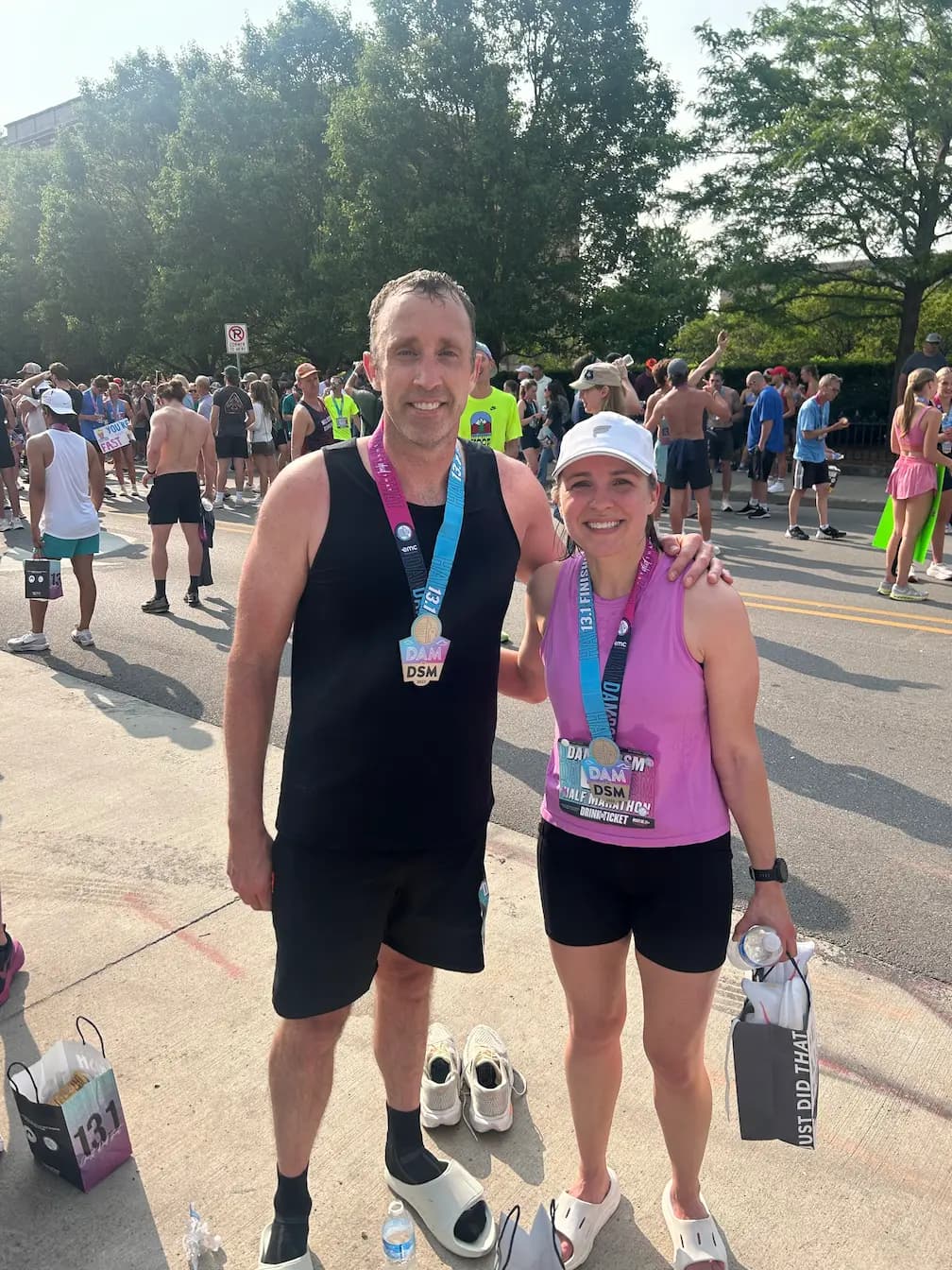
Phil Parker
Phil is a seasoned distance runner and web developer based in Iowa. He has run 15+ half marathons and 2 full marathons, and built PR Nerd because he was tired of paying for running apps that did not use real training science.
More about Phil →Comments
No comments yet. Be the first.
Leave a comment
Not published
0/1000
Ready to put this into practice?
Build your free personalized training plan based on your actual fitness — not your goal.
Build my plan →Get monthly running research, pace strategies, and fresh training articles. Zero fluff.