

The Norwegian Method for Runners: 4x4 vs Singles vs Double Threshold
The Norwegian 4x4, Norwegian singles, and double threshold are three very different workouts. Here's what each one is, who it's for, and which one regular runners should actually use.
This morning I ran my first workout since my marathon: a Norwegian 4x4. Four times four minutes hard, with easy recovery in between. I hit 6:51 to 6:59 per mile on every rep, my heart rate topped out at 176, and I finished feeling like I'd done real work without wrecking myself.
If you spend any time around running podcasts or training forums, you've probably heard the word "Norwegian" attached to a few different things. The Norwegian 4x4. Norwegian singles. The Norwegian double threshold method the Ingebrigtsen brothers made famous. They all sound related, and people mix them up constantly.
They're actually three very different approaches. One is built around going hard. One is built around never quite going hard. And one is built for elite runners who train twice a day.
Here's what each one is, what the research says, and which one a regular runner should actually use.
The Three Norwegian Methods at a Glance
| Norwegian 4x4 | Norwegian Singles | Double Threshold | |
|---|---|---|---|
| The idea | Short, hard intervals to raise VO2 max | Lots of "almost hard" running, once a day | Lots of threshold running, twice a day |
| Typical workout | 4 x 4 min hard, 3 min easy | 8–10 x 3 min, 5–6 x 6 min, or 3 x 10 min | Two threshold sessions in one day |
| How hard | 90–95% of max heart rate | Comfortably hard, just under threshold | Just under threshold, controlled with a lactate meter |
| How often | 1–2 times a week | About 3 times a week | Usually 2 days a week (4 sessions) |
| Who it's for | Runners with a consistent running base | Amateurs, especially half and full marathoners | Elite and sub-elite runners |
| Research | Strong | Very little on singles itself | Mostly elite case studies |
The Norwegian 4x4
The 4x4 comes out of research at the Norwegian University of Science and Technology (NTNU). The workout is simple:
- Warm up
- Run 4 minutes hard, at about 90 to 95% of your max heart rate
- Recover for 3 minutes with easy running or walking
- Repeat 4 times
- Cool down
The best-known study behind it (Helgerud and colleagues, 2007) compared different ways of training at the same total workload in 40 moderately trained men. Over eight weeks, the 4x4 group improved VO2 max by 7.2%, while the groups doing long, easy running or steady threshold running didn't improve significantly. That's a big reason the 4x4 became the go-to "VO2 max workout." The original study used 90 to 95% of max heart rate. Many practical versions use a slightly wider range, but 90% or above by the end of each rep is the target. (If you're curious how your watch estimates VO2 max in the first place, I covered that in is your Garmin VO2 max accurate?)
Since then, the 4x4 has also become popular in the health and longevity world, because it's relatively short, simple, and adaptable for people who aren't serious runners. NTNU's Generation 100 study followed 1,567 older adults for five years, including 400 assigned to twice-weekly high-intensity interval training. That group had a lower observed death rate than the control group, but the difference wasn't statistically significant. It's an interesting finding, but not proof that 4x4 workouts extend your life.
My 4x4 this morning:
- Pace: 6:51 to 6:59 per mile on all four reps. For comparison, my most recent 5K (21:58) works out to about 7:04 per mile, so these were just a touch faster than 5K pace. That's right where VO2 max intervals should be.
- Heart rate: It peaked at 176. My max is about 190, so that's about 93% of max, right in the 90 to 95% range the original research used.
- Garmin Training Effect: My Forerunner 255 gave me 3.1 aerobic ("improving") and 2.0 anaerobic ("maintaining"). That fits the workout. The 4x4 is a hard aerobic session, not a sprint workout.
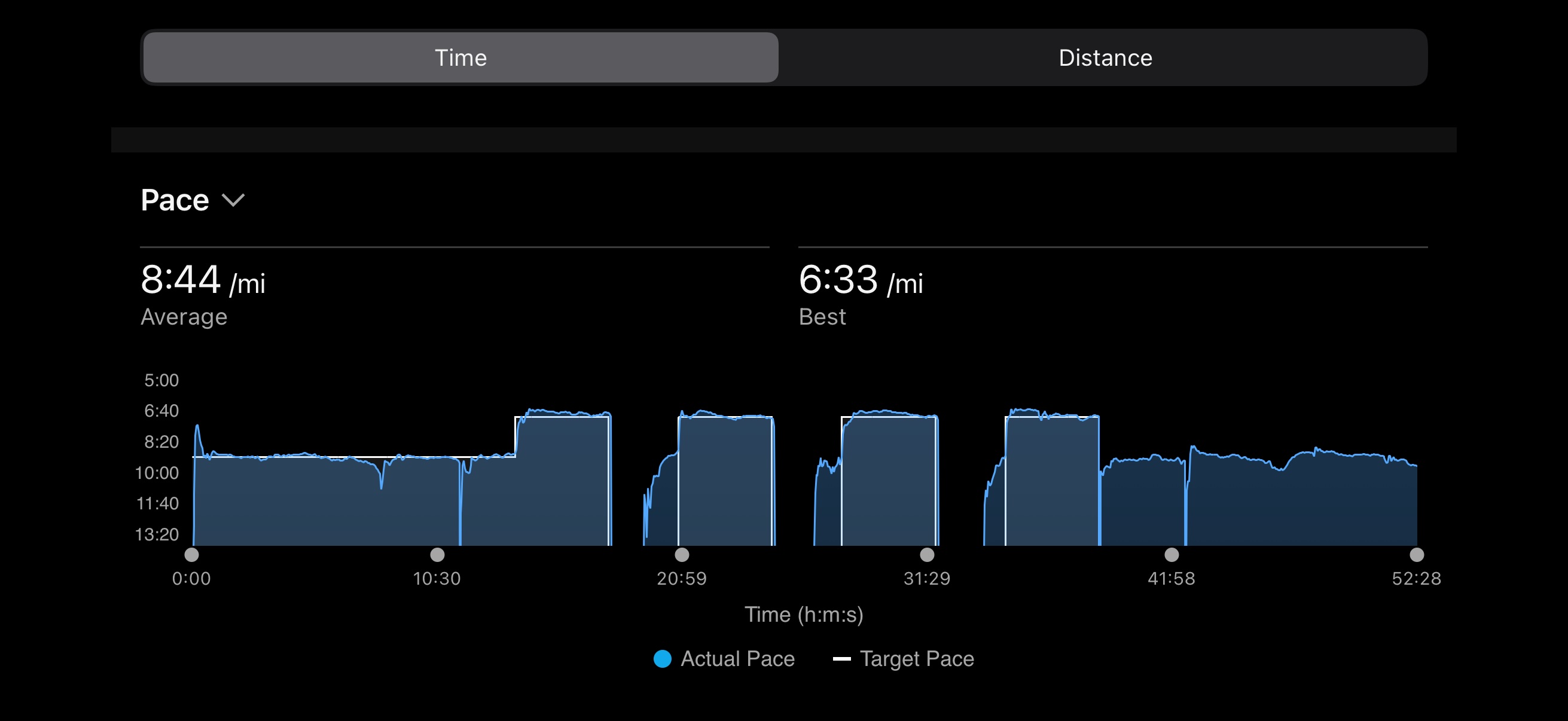
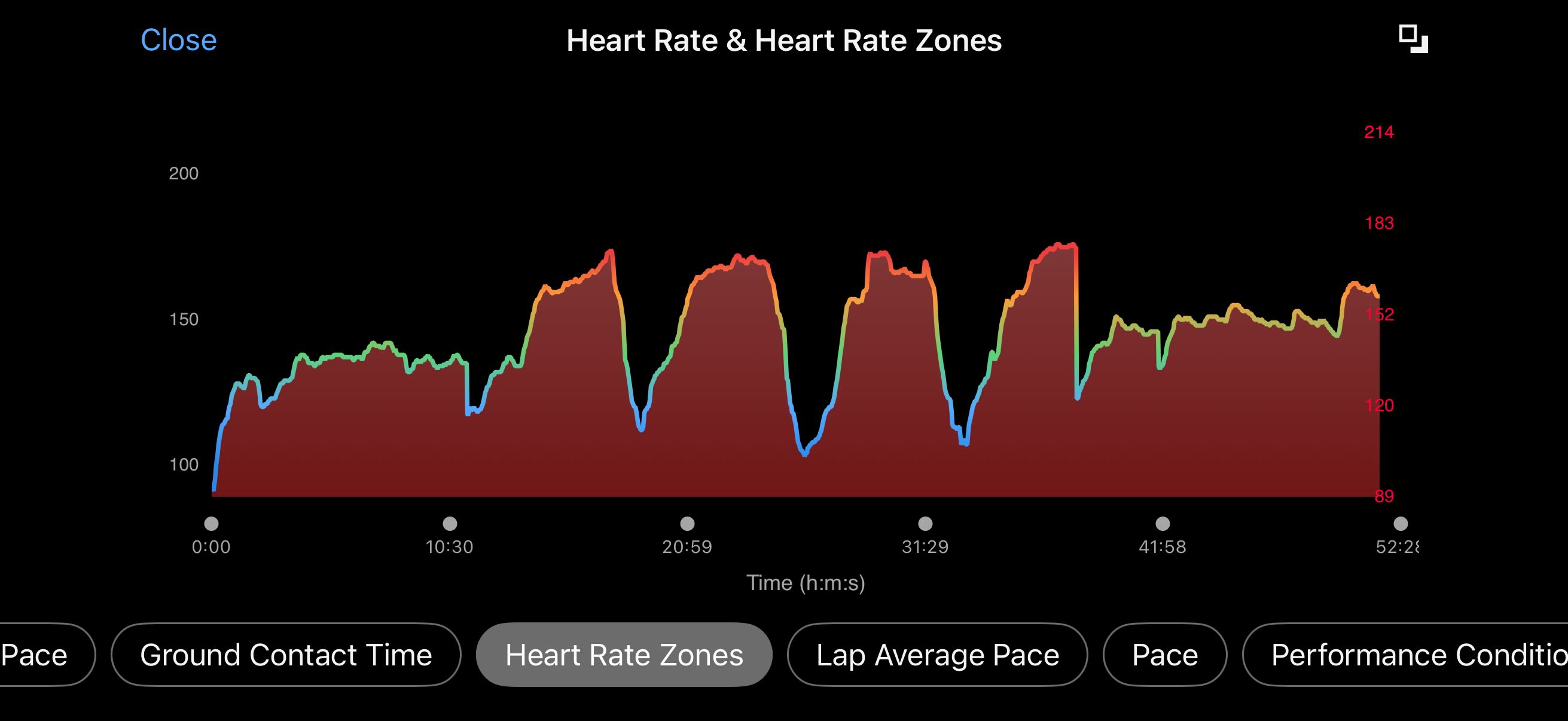
Notice how heart rate climbs through each rep. It doesn't hit its peak right away. On a 4x4, the first minute of each rep often feels easier than it should, and the last minute is where you actually reach the target zone. That's normal, and it's one reason the reps are four minutes long. Shorter reps don't give your heart rate enough time to get up there.
How to pace your own 4x4: If you know your max heart rate, aim to reach about 90 to 95% of it by the second half of each rep. Without a reliable max heart rate, use effort as your guide: run hard but controlled, roughly around 5K race effort for many runners. Since heart rate lags behind effort, pace and feel are useful even if you do track heart rate. You should be working hard by the second half of each interval, but still able to hold consistent pacing across all four. If you're dying on rep four, you started too fast.
Norwegian Double Threshold
This is the system most people mean when they say "the Norwegian method." It's associated with Norwegian distance runners like Marius Bakken in the 2000s and, more recently, the Ingebrigtsen brothers.
The core ideas:
- Two threshold workouts in one day, usually twice a week. For example, 5 x 2K in the morning and 10 x 1K in the afternoon.
- Controlled with a lactate meter. Runners prick a finger between reps to measure blood lactate and keep it just under lactate threshold. One published example uses about 2.5 millimoles in the morning session and 3.5 in the afternoon. Those numbers aren't universal targets, though. Coaches adjust them based on the athlete, the workout, and each runner's individual lactate response.
- Lots of volume at that controlled intensity. Staying just under threshold is the whole trick. It lets elite runners do a huge amount of quality running without the fatigue that comes from going harder.
- Usually one harder session a week, like hill sprints or faster reps. Everything else is easy.
It works for elites because they often run 100 or more miles a week, train twice a day, and have their whole life built around recovery.
Why I'm not doing it: I'm a 44-year-old marathoner with a full-time job, not a professional miler. I don't have time to train twice a day, my body wouldn't recover from it, and honestly, I'm not that intense. That's true for almost everyone reading this. Double threshold is fascinating, but it's not built for us.
Norwegian Singles
This is the one that's taken over online running communities. It started around 2023 on the LetsRun forum, when an amateur runner who posted as "sirpoc84" described how he adapted the double threshold idea for someone who can only train once a day. Hence the name: singles.
The basic structure:
- Three sub-threshold workouts a week, one per day, often something like Tuesday, Thursday, and Saturday.
- Everything else is easy, including the long run.
- Traditional VO2 max intervals aren't the focus. The emphasis is on piling up a lot of time just below threshold while keeping the rest of your running easy. That's the biggest difference from the 4x4. Some versions still include strides, hill sprints, or faster race-specific work.
Norwegian singles isn't one official, standardized plan. It's an approach that grew out of a running community, and different runners set it up differently. If you're new to it, build up to three sessions a week rather than jumping straight in. Starting with one or two and adding the third after a few weeks is a lot easier on your body.
"Sub-threshold" means a little slower than a typical tempo run. It should feel comfortably hard, never hard. You should finish every workout feeling like you could have done another rep or two.
The commonly used pace guidelines depend on how long the reps are:
| Rep length | Typical workout | Rough pace |
|---|---|---|
| Short (about 3 min) | 8–10 x 3 min, 1 min easy | About 15K race pace |
| Medium (about 6 min) | 5–6 x 6 min, 1 min easy | About half marathon pace |
| Long (10+ min) | 3 x 10 min, 1–2 min easy | About 30K race pace (between half and marathon pace) |
For me, based on my 3:33 marathon, that works out to roughly 7:40 per mile for 3-minute reps, about 7:50 for 6-minute reps, and about 8:00 for 10-minute reps. Those are starting estimates, not official singles prescriptions. Use a recent race result to get yours, then adjust based on how the workouts feel. If you're finishing sessions strained, slow down. You can get your own race-pace estimates from our running pace calculator.
Why runners like it: It's simple, the workouts are hard enough to feel productive without leaving you wrecked, and doing three of them a week adds up to a lot of quality running. Many runners also feel it's easier on their body than repeated VO2 max sessions. A lot of amateurs have reported big improvements, especially in the half and full marathon.
The honest caveat: There's very little formal research on Norwegian singles specifically. Most of the evidence is runners' own reports, plus the broader research showing that threshold-type training improves endurance. That doesn't mean it doesn't work. It just means we don't have studies comparing it directly against other approaches yet.
If you want more on what "threshold" actually means and how it differs from a tempo run, I covered that in tempo run vs threshold run.
4x4 vs Singles: Almost Opposite Philosophies
What I find interesting is how different these two are, despite both being "Norwegian."
- The 4x4 says: a small dose of very hard running. Time at high aerobic intensity, once or twice a week, to push your VO2 max up.
- Singles says: a big dose of comfortably hard running. A lot of controlled work just below threshold, about three times a week, to build your threshold and durability. Sub-threshold running is still demanding, and it doesn't mean you never run faster. It's just not the focus.
Neither one is wrong. They target different things. VO2 max work raises your ceiling. Threshold work raises how close to that ceiling you can run for a long time. For a 5K, the ceiling matters a lot. For a marathon, how long you can run close to it matters more. That's a big reason singles has caught on with half and full marathoners.
Which One Should You Do?
If you're a newer runner: Honestly, neither yet. If you've been running for less than about a year, easy miles, consistency, and maybe some strides will do more for you than any Norwegian workout. I covered what to focus on in how long it takes to get faster at running.
If you race 5Ks and 10Ks: The 4x4 is a great once-a-week workout, especially paired with one threshold or tempo session.
If you're a half or full marathoner: Singles fits your goals well. Even two sub-threshold sessions a week, with everything else easy, is a solid structure.
If you're short on time: The 4x4 takes about 35 to 40 minutes with a warmup and cooldown, and it's hard to beat for the time it takes.
If you're an elite: You probably don't need a blog post. But double threshold is the one getting all the attention.
Whatever you choose, keep your easy days easy. All three Norwegian methods only work because most of the running around them is truly easy. If you're not sure what easy means for you, our Zone 2 heart rate calculator is a good place to start, and I wrote about why your watch's Zone 2 might be off.
My Off-Season Plan
I'm in my off-season after running a 19-minute marathon PR at 44, and I'm planning on two workouts a week. Today was a 4x4. Over the next few weeks, I'm going to try singles-style sub-threshold sessions too, likely two a week instead of the usual three, since I'm keeping my overall training lighter this time of year.
I'll update this article with my singles workouts, including paces, heart rate, and how they compare to the 4x4, so check back in a few weeks.
FAQ
What is the Norwegian 4x4 workout? Four intervals of 4 minutes at about 90 to 95% of your max heart rate, with 3 minutes of easy recovery between them. It comes from research at the Norwegian University of Science and Technology and is mainly used to improve VO2 max.
What is Norwegian singles running? An amateur-friendly version of the Norwegian double threshold method. Instead of two threshold sessions in one day, you do one sub-threshold workout a day, about three times a week, with all other running easy.
What's the difference between Norwegian singles and double threshold? Double threshold means two threshold sessions in the same day, usually controlled with a lactate meter, and it's built for elites running very high mileage. Singles is one session a day, guided by pace, heart rate, or feel.
Is the Norwegian 4x4 good for runners? Yes. It's an efficient way to improve VO2 max, and it fits easily into most training plans as a once-a-week workout. Just keep the rest of your week mostly easy.
How fast should Norwegian singles workouts be? A little slower than threshold. A common guideline is about 15K pace for 3-minute reps, half marathon pace for 6-minute reps, and about 30K pace for 10-minute reps. These are starting points, so adjust based on how the workouts feel. Every session should feel comfortably hard, never all-out.
Can you do the 4x4 and singles together? You can, but be careful not to stack too much hard running. Most runners would do best with either one 4x4 plus one or two sub-threshold sessions a week, or singles on its own.
This article is for general information and isn't medical advice. If you have a heart condition or other health concerns, talk to your doctor before starting high-intensity interval training.
Sources
- Helgerud, J., Høydal, K., Wang, E., et al. (2007). Aerobic high-intensity intervals improve VO2max more than moderate training. Medicine and Science in Sports and Exercise, 39(4), 665–671.
- Stensvold, D., Viken, H., Steinshamn, S. L., et al. (2020). Effect of exercise training for five years on all cause mortality in older adults (the Generation 100 study): randomised controlled trial. BMJ, 371, m3485.
- Casado, A., Foster, C., Bakken, M., & Tjelta, L. I. (2023). Does lactate-guided threshold interval training within a high-volume low-intensity approach represent the "next step" in the evolution of distance running training? International Journal of Environmental Research and Public Health, 20(5), 3782.
- LetsRun forum discussion of the "Norwegian singles" approach (sirpoc84).
Related Articles
Tempo Run vs Threshold Run: What's the Difference, and Does It Matter?
Tempo run and threshold run usually mean the same workout, but not always. Here's what lactate threshold actually is, how fast your tempo runs should be, the benefits and risks, and why your Garmin might label it differently.
10 min readHow to Run Your First Sub-2 Hour Half Marathon
Breaking 2 hours in the half marathon is one of the most popular goals in running. Here's exactly what it takes to get there and what most runners get wrong along the way.
7 min readStrength Training for Runners: What the Research Actually Says
Runners think lifting weights will slow them down or that it is the key to staying injury free. The truth is more nuanced than either camp admits. Here is what the science actually shows.
7 min read
Phil Parker
Phil is a seasoned distance runner and web developer based in Iowa. He has run 15+ half marathons and 3 full marathons, and built PR Nerd because he was tired of paying for running apps that did not use real training science.
More about Phil →Follow on Strava →Comments
No comments yet. Be the first.
Leave a comment
Not published
0/1000
Ready to put this into practice?
Build your free personalized training plan based on your actual fitness — not your goal.
Build my plan →Get monthly running research, pace strategies, and fresh training articles. Zero fluff.