
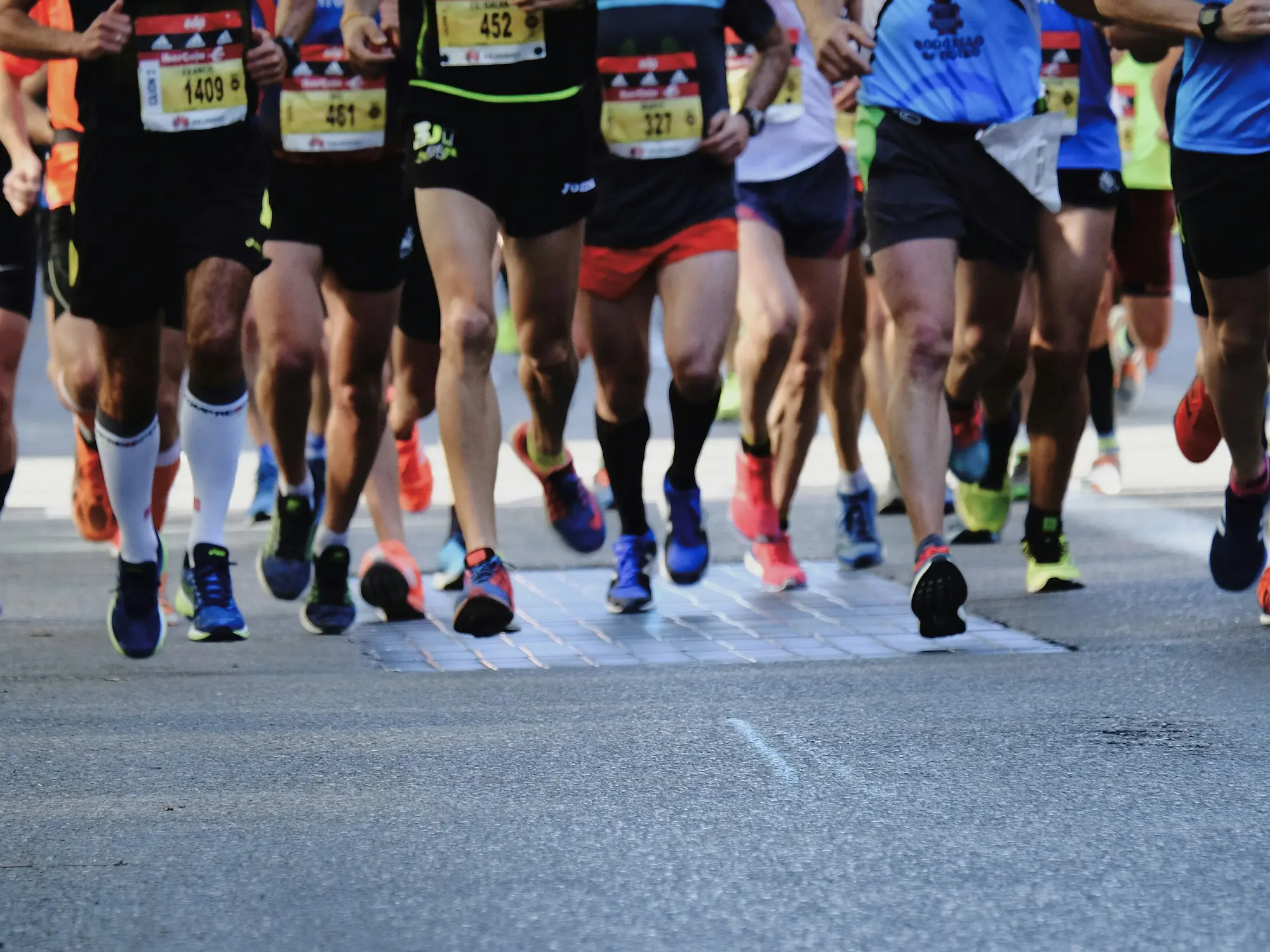
Protein for Runners: How Much You Need, When It Matters, and Why It Isn't Fuel
How much protein do runners need? Less than the gym says, and timing matters more than most people think. Here's what the research says, when protein actually helps, and why it doesn't belong in your long run.
Spend a few minutes in a beginner running group on Facebook and you'll see it. Someone asks what to eat before their first half marathon, and the replies roll in: a big steak dinner the night before, a protein shake before the long run, a protein bar at mile 8.
I get why. Protein has a great reputation. It's on every label at the grocery store, it's what every gym person talks about, and it sounds like the healthy choice. But protein isn't what powers your running, and loading up on it at the wrong time is a great way to spend part of your race in a porta-potty.
Protein still matters a lot for runners. It just has a different job than most people think. This article covers how much you really need, when it actually matters, the best sources, and what to eat (and skip) before a long run or race. There's also a calculator to work out your own numbers.
This article is for general education, not medical advice. If you have kidney disease, another health condition, or a history of disordered eating, talk to your doctor or a registered dietitian before changing how you eat.
What's In This Guide
- Protein Is Not Fuel
- Where the "Protein as Fuel" Idea Comes From
- What Protein Actually Does for Runners
- How Much Protein Do Runners Need?
- Runner's Protein Calculator
- When Protein Matters Most
- Runners Who Need a Little More
- Protein Before Long Runs and Races
- The Best Protein Sources for Runners
- Protein Shakes and Supplements
- FAQ
Protein Is Not Fuel
When you run, your body burns two main fuels: carbohydrates and fat. Carbs, stored as glycogen in your muscles and liver, are the fuel you lean on more and more as the pace picks up. Fat covers a lot of the work at easy paces. That's why marathoners take gels, and why runners carb-load before a race instead of protein-loading.
Your body does break down a little protein for energy during exercise, especially late in a long run when glycogen is running low. But it's a small slice of the total, and it isn't something you can "top off" by eating protein beforehand. Protein you eat today isn't sitting around waiting to power tomorrow's run.
Researchers have tested adding protein to sports drinks during endurance exercise, and the results are pretty clear. When athletes get enough carbohydrate, adding protein doesn't make them faster. A 2014 systematic review in Sports Medicine came to that conclusion, and a McMaster University study on cyclists found the same thing: the sports drink helped, and the added protein didn't help any more.
So if protein isn't fuel, what's the harm in eating it before or during a run? Your stomach. Protein, fat, and fiber all slow down digestion. A big dose of any of them before or during a hard effort means food sitting in your gut while you're asking your body to send blood to your legs. That's a recipe for cramps, nausea, and an unplanned stop.
Where the "Protein as Fuel" Idea Comes From
I don't think anyone is crazy for believing this. A few things push people that way:
- Gym culture. Most people learn about protein from lifting, where protein shakes are everywhere and more is usually treated as better. That advice gets carried straight over to running.
- Marketing. "High protein" is printed on cereal, chips, coffee, and pancake mix. When everything is selling protein, it starts to feel like the answer to everything.
- Mixing up recovery and fuel. Protein really does help you recover from hard training. Somewhere along the way, "good for runners" turned into "good to eat right before running."
- Old sports drink studies. Some early research suggested protein in a sports drink could help endurance. Later, better-designed studies mostly found that the benefit disappeared once athletes got enough carbs, but the idea stuck around.
What Protein Actually Does for Runners
Every run, especially a long run or a hard workout, causes small amounts of damage in your muscles. Your body repairs that damage and adapts, and that's how training makes you stronger. Protein provides the building blocks for that repair.
Protein also helps with:
- Building and keeping muscle, which matters more for runners than most people think, especially as we get older
- Adapting to training, including building the parts of your muscles that use oxygen
- Recovery between hard sessions, so you're ready for the next one
- Immune function and healing, including coming back from injuries
- Feeling full, which helps if you're trying to manage your weight
So protein is important. It just works behind the scenes, between runs, not during them.
How Much Protein Do Runners Need?
You've probably heard "1 gram per pound of body weight." That's a gym rule of thumb, and for most runners, it's on the high side.
Here's what the research and the major sports nutrition groups say:
| Guideline | Per kg of body weight | Per pound | For a 160 lb runner |
|---|---|---|---|
| Basic daily need for adults (RDA) | 0.8 g/kg | 0.36 g/lb | about 58 g |
| Athletes (ACSM, Academy of Nutrition and Dietetics, Dietitians of Canada) | 1.2–2.0 g/kg | 0.55–0.9 g/lb | about 87–145 g |
| Exercising people (International Society of Sports Nutrition) | 1.4–2.0 g/kg | 0.64–0.9 g/lb | about 102–145 g |
| The gym rule | 2.2 g/kg | 1.0 g/lb | 160 g |
So runners do need more than a couch-bound adult. Basic guidelines are written for people who don't train, and that's not you. But for most runners, the right range lands somewhere between about 0.55 and 0.8 grams per pound, not 1 gram.
One interesting study backs this up. In 2016, researchers measured protein needs in six trained male endurance runners on a training day that included a 20-kilometer run. They estimated an average requirement of about 1.65 grams per kilogram and a recommended intake of about 1.83 grams per kilogram. That's more than double the basic guideline, but still below the gym's 1 gram per pound. It was a very small study, so I wouldn't treat the exact numbers as gospel, but it supports the idea that endurance athletes need more protein than people who don't train.
Where you land in that range depends on how hard you're training. An easy base-building week needs less than a 50-mile marathon block. If you're trying to lose weight, eating toward the higher end helps you hang on to muscle while you're in a calorie deficit.
Runner's Protein Calculator
Plug in your weight and how hard you're training to see your daily range, how much to aim for at each meal, and how much to get after a hard run. Then add up what you eat in a typical day to see how close you are.
Runner's Protein Calculator
Find your daily protein range, then add up what you eat to see how close you are.
Tap + to add what you eat in a typical day.
Ranges are based on sports nutrition position stands for athletes (1.2–2.0 g/kg a day). Food values are approximate. This is general guidance, not medical advice. If you have kidney disease or another health condition, follow your doctor's advice.
If you're like most runners, you might be surprised how quickly protein adds up from normal food. A couple of eggs, a cup of Greek yogurt, a chicken breast at dinner, and a glass of milk add up to more than 60 grams before you count anything else.
When Protein Matters Most
This is the part I think matters more than the daily total. For runners, when you eat protein makes a real difference.
After long runs, races, and hard workouts. This is the big one. After a long run, a tempo, an interval session, or a race, your muscles need to repair. Getting a solid dose of protein after those runs helps that process along. Aim for roughly 20 to 40 grams, depending on your size, or about 0.25 to 0.3 grams per kilogram of body weight.
You don't need to panic about a 30-minute "anabolic window," though. Your body stays responsive to protein for many hours after exercise. Getting enough throughout the day matters more than hitting an exact minute on the clock.
With carbs, not instead of them. After a long run, you need to refill your glycogen and repair your muscles. That's why carbs plus protein beats protein alone, and it's why chocolate milk shows up in so much recovery research. It's cheap, easy, and has both.
Spread out through the day. Your body uses protein better in a few moderate doses than in one huge meal. The International Society of Sports Nutrition suggests about 20 to 40 grams every 3 to 4 hours. In real life, that means some protein at breakfast, lunch, dinner, and maybe a snack, rather than a little at breakfast and a giant steak at dinner.
Before bed. Some research has found that 30 to 40 grams of casein protein before bed increases muscle repair overnight. Casein is the slow-digesting protein in milk, cottage cheese, and Greek yogurt. A bowl of Greek yogurt or cottage cheese is an easy way to try this, especially after a hard day.
Here's what I do. I try to get most of my protein from normal food: eggs, Greek yogurt, chicken, and so on. But after most long runs and hard workouts, I drink a Nurri protein shake. It's 30 grams of protein from ultra-filtered milk, it's easy to keep in the fridge, and when I'm tired and not hungry after a long run, it gets protein in fast without me having to cook anything. Then I eat a real meal with plenty of carbs a little later.
Runners Who Need a Little More
Some runners should aim for the higher end of the range:
Masters runners and aging athletes. This one is personal. As we get older, our muscles respond less to the same amount of protein. In a 2015 study, younger men (around 22 years old) maximized muscle building with about 0.24 grams of protein per kilogram in a meal, while older men (around 71) needed about 0.40 grams per kilogram.
The difference isn't a switch that flips when you turn 40. The research showing higher protein needs per meal has mostly studied older adults, so don't assume every 40-year-old runner needs the same intake as someone in their 70s. But keeping muscle becomes more important as we age, and getting a solid dose of protein at each meal, not just after workouts, is a smart habit. I wrote more about training after 40 in Masters Running: How to Keep Getting Faster After 40.
Runners trying to lose weight. When you're eating fewer calories than you burn, more protein helps you keep muscle while you lose fat. It also helps you feel full. If you've been running a lot and the scale isn't moving, check out Can Runners Eat Whatever They Want? Why You're Not Losing Weight.
Plant-based runners. You can absolutely get enough protein without meat, but most plant proteins have less leucine, the amino acid that kick-starts muscle repair. Eating a bit more total protein and mixing sources, like beans with grains, or adding soy foods like tofu, tempeh, and edamame, helps cover that.
Runners coming back from injury. Healing tissue needs protein, and so does holding on to muscle while you're running less.
Don't let protein crowd out your carbs. This is an easy trap to fall into. If you chase a huge protein number during marathon training, it's easy to fill up on chicken and protein shakes and end up short on the carbohydrates that actually fuel your running. Hit a reasonable protein target, then let carbs fill the rest of the plate, especially during heavy training.
One important note: protein can't fix under-eating. If you're not eating enough total food for how much you're running, extra protein won't save your recovery. Your body needs enough carbs and overall calories first.
Protein Before Long Runs and Races
This is where the Facebook advice goes off the rails, so let's clear it up.
The night before a half or full marathon: Make carbs the star of your plate. Include a moderate serving of protein if you want it, but skip unusually large, heavy, or fatty meals. Pasta, rice, bread, and potatoes should be doing most of the work. The goal is to top off your glycogen and keep your stomach comfortable, not to avoid protein entirely. Sports nutrition guidelines recommend pre-event meals that are lower in fat and fiber and moderate in protein for exactly that reason.
Personally, I keep protein to a minimum the night before a half or full marathon. Pasta, rice, bread, and potatoes are the main event, and I skip the big steak. I've never had a porta-potty emergency in a race, and I don't plan to start now. If you want the full plan for the day or two before a race, check out The 24-36 Hour Fuel Window.
Race morning and before long runs: Stick with simple, familiar carbs. A banana, toast, a bagel, or oatmeal are all common choices. A little protein, like some peanut butter on toast, is fine if it sits well with you, but a protein shake right before a long run isn't helping your run, and it may hurt your stomach.
During long runs and races: Carbs, water, and electrolytes. For typical long runs, half marathons, and marathons, protein isn't something you need to plan into your fueling. Ultra-distance events can have different nutrition considerations, but carbs are still the priority there, too. If you want help with that part, check out How to Fuel Long Runs and Races and Electrolytes for Long Runs.
After: Now's the time. Get your protein, along with carbs and fluids.
The Best Protein Sources for Runners
I always try food first. Whole foods give you protein plus a bunch of other nutrients runners need, like iron, calcium, and vitamin D. Here are some easy options:
| Food | Serving | Protein (about) |
|---|---|---|
| Chicken breast | 3 oz cooked | 26 g |
| Lean ground beef (90%) | 3 oz cooked | 22 g |
| Salmon | 3 oz cooked | 22 g |
| Canned tuna | 3 oz drained | 20 g |
| Greek yogurt (plain, nonfat) | 3/4 cup (6 oz) | 17 g |
| Cottage cheese | 1/2 cup | 12 g |
| Tofu (firm) | 1/2 cup | 10 g |
| Lentils | 1/2 cup cooked | 9 g |
| Edamame | 1/2 cup shelled | 9 g |
| Milk | 1 cup | 8 g |
| Black beans | 1/2 cup cooked | 8 g |
| Pasta | 1 cup cooked | 8 g |
| Cheese | 1 oz | 7 g |
| Peanut butter | 2 tbsp | 7 g |
| Eggs | 1 large | 6 g |
| Almonds | 1 oz | 6 g |
Dairy is especially handy for runners. Milk, Greek yogurt, and cottage cheese have high-quality protein, a mix of fast- and slow-digesting protein, and plenty of leucine, plus calcium for your bones.
Protein Shakes and Supplements
You don't need protein powder or shakes to be a good runner. They're a convenience, not a requirement. But they're useful when:
- You're not hungry after a long run or hard workout, but you want protein in quickly
- You're busy and short on time
- You have trouble getting enough protein from food, especially on a plant-based diet
If you use them, here are a few tips:
- Pick a third-party tested product. Supplements aren't tightly regulated. An older international study, published in 2004, found steroids that weren't listed on the label in 14.8% of the 634 supplements it tested. That research is dated, but it shows why independent third-party testing matters. Look for the NSF Certified for Sport or Informed Sport logos, especially if you race at a level with drug testing.
- Check the label. Some shakes are loaded with sugar, and some have much less protein than you'd think.
- Use it after runs, not before or during them. That's where it actually helps.
FAQ
How much protein does a runner need per day? Most runners do well with about 1.2 to 2.0 grams per kilogram of body weight per day, or about 0.55 to 0.9 grams per pound. Train harder, or try to lose weight, and you'll want to be toward the higher end. For a 160-pound runner, that's roughly 87 to 145 grams a day.
Is 1 gram of protein per pound too much for runners? For most runners, it's more than you need. It isn't dangerous for most healthy people, but those extra calories are usually better spent on carbohydrates, which are what actually fuel your running.
Should I eat protein before a run? A small amount, like peanut butter on toast, is fine if it sits well with you. But protein doesn't fuel your run, and a big dose before a long run or race can upset your stomach. Focus on carbs before running.
Should I take protein during a long run or marathon? For typical long runs, half marathons, and marathons, no. Research shows protein doesn't improve endurance performance when you're getting enough carbohydrates, and it can upset your stomach. Stick with carbs, fluids, and electrolytes. Ultras can be a little different, but carbs are still the priority.
How much protein should I eat after a run? After long runs, races, and hard workouts, aim for roughly 20 to 40 grams of protein, depending on your size, along with carbs. Sooner is convenient, but you don't need to hit a 30-minute window. Older runners may benefit from the higher end of that range.
Should I eat protein the night before a marathon? Keep it light. Your dinner the night before should focus on carbohydrates, with low fat and fiber and only modest protein, so your stomach is ready on race morning.
Is chocolate milk good for recovery? Yes. It has a good mix of carbs and protein, it's cheap, and it's easy to drink when you're not hungry. That's why it shows up in so much recovery research.
Do I need protein powder? No. Most runners can get enough protein from food. Powders and shakes are helpful for convenience, especially after hard workouts, but they're not required.
This article is for general information and isn't medical advice. If you have a medical condition, especially kidney disease, talk to your doctor or a registered dietitian before increasing your protein intake.
Sources
- Thomas, D. T., Erdman, K. A., & Burke, L. M. (2016). Position of the Academy of Nutrition and Dietetics, Dietitians of Canada, and the American College of Sports Medicine: Nutrition and athletic performance. Journal of the Academy of Nutrition and Dietetics, 116(3), 501–528.
- Jäger, R., et al. (2017). International Society of Sports Nutrition position stand: protein and exercise. Journal of the International Society of Sports Nutrition, 14, 20.
- Rodriguez, N. R., Di Marco, N. M., & Langley, S. (2009). American College of Sports Medicine position stand: Nutrition and athletic performance. Medicine & Science in Sports & Exercise, 41(3), 709–731.
- Kato, H., Suzuki, K., Bannai, M., & Moore, D. R. (2016). Protein requirements are elevated in endurance athletes after exercise as determined by the indicator amino acid oxidation method. PLoS One, 11(6), e0157406.
- Moore, D. R., et al. (2015). Protein ingestion to stimulate myofibrillar protein synthesis requires greater relative protein intakes in healthy older versus younger men. The Journals of Gerontology: Series A, 70(1), 57–62.
- McLellan, T. M., Pasiakos, S. M., & Lieberman, H. R. (2014). Effects of protein in combination with carbohydrate supplements on acute or repeat endurance exercise performance: a systematic review. Sports Medicine, 44(4), 535–550.
- van Essen, M., & Gibala, M. J. (2006). Failure of protein to improve time trial performance when added to a sports drink. Medicine & Science in Sports & Exercise, 38(8), 1476–1483.
- Knuiman, P., Hopman, M. T. E., Verbruggen, C., & Mensink, M. (2018). Protein and the adaptive response with endurance training: wishful thinking or a competitive edge? Frontiers in Physiology, 9, 598.
- Geyer, H., et al. (2004). Analysis of non-hormonal nutritional supplements for anabolic-androgenic steroids: results of an international study. International Journal of Sports Medicine, 25(2), 124–129.
- U.S. Department of Agriculture. FoodData Central (food protein values, rounded).
Get a race-day fueling plan with our fueling calculator, and build your free personalized training plan from your actual fitness. Build your plan now.
Related Articles
When Are You Ready to Move Up? From 5K to 10K to Half Marathon to Marathon
Run two 5Ks and already signed up for a marathon? Or stuck at 5Ks forever? Here's when you're actually ready to move up in race distance, what each step takes, and a quick readiness check.
8 min readThe 24-36 Hour Fuel Window: What to Eat (and Skip) Before Your Half or Full Marathon
Part 2 of our Race Prep Series: the exact carb, protein, electrolyte, and hydration playbook for the 24 to 36 hours before a half or full marathon, backed by the research.
9 min readMasters Running: How to Keep Getting Faster After 40
You can't outrun a bad diet anymore, but you can still get faster after 40. What changes for masters runners in training, speed work, strength, nutrition, creatine, warmups, and recovery, from a 44-year-old who just ran a 19-minute marathon PR.
11 min read
Phil Parker
Phil is a seasoned distance runner and web developer based in Iowa. He has run 15+ half marathons and 3 full marathons, and built PR Nerd because he was tired of paying for running apps that did not use real training science.
More about Phil →Follow on Strava →Comments
No comments yet. Be the first.
Leave a comment
Not published
0/1000
Ready to put this into practice?
Build your free personalized training plan based on your actual fitness — not your goal.
Build my plan →Get monthly running research, pace strategies, and fresh training articles. Zero fluff.