

Is Heel Striking Bad? No. Overstriding Is the Real Problem.
Most runners heel strike, including most elites. The research is clear on that. What actually predicts injury risk is not which part of your foot lands first, it is whether you are overstriding. Here is the research, properly cited, and what to actually do about it.
If you have spent any time in running forums or comment sections, you have probably absorbed the idea that heel striking is a flaw to be corrected. Minimalist shoes, barefoot running advocates, and a wave of "fix your form" content over the last fifteen years have made heel striking sound like something closer to a diagnosis than a description.
The research does not support that. Heel striking is not rare, it is not abnormal, and it is not what predicts injury risk on its own. What actually matters is something else entirely, and it gets confused with foot strike far too often.
Most Runners Heel Strike, For Real
This is not a fringe finding from one small study. It is one of the more consistently replicated results in running biomechanics research.
Kerr et al. (1983)1 filmed 753 runners at the 10K and marathon distance and found that 81 percent used a rearfoot (heel) strike, 19 percent used a midfoot strike, and effectively none used a true forefoot strike. Larson et al. (2011)2 examined 936 recreational runners at the 10K mark of a half or full marathon and found 88.9 percent were rearfoot strikers. Kasmer et al. (2013)3 classified 1,991 runners at the Milwaukee Lakefront Marathon and found a 93.67 percent heel-strike prevalence, the highest reported in a large field study.
The detail that surprises people most is Hasegawa et al. (2007)4, which examined 283 elite runners at actual race pace in the Sapporo International Half Marathon and still found 74.9 percent were heel striking. These are not recreational joggers shuffling through an easy run. These are elite half marathoners at competition pace, and three out of four of them are still landing on their heel first.
Depending on which study you look at, the number sits somewhere between roughly 75 and 94 percent. However you slice it, heel striking is not the exception. It is what the large majority of runners, fast and slow, actually do.
One more finding worth sitting with: a study of 710 runners5 found that only 42.7 percent could accurately identify their own foot strike pattern when compared against actual biomechanical measurement. Most runners genuinely do not know what their foot is doing. If you have never had this measured, do not assume you know either.
The Real Culprit Is Overstriding, Not Foot Strike
Here is the distinction that gets lost in most of the popular writing on this topic. The question is not "does your heel touch the ground first." The question is "where does your foot land relative to your center of mass."
A runner can heel strike gently, with the foot landing close to underneath the hips, and generate relatively low impact forces. A runner can also heel strike with the foot landing well out in front of the body, with a nearly straight leg absorbing the full braking force of that stride. The first runner is fine. The second runner is overstriding, and overstriding is what actually correlates with the impact spikes that predict injury, regardless of which part of the foot happens to touch down first.
One useful, measurable marker: research on gait mechanics associates a shin angle greater than roughly 20 degrees from vertical at initial contact with overstriding, independent of foot strike classification. If your foot is landing far enough ahead of you that your shin is angled sharply forward at contact, that is the actual problem, not the heel strike itself.
Why Cadence, Not Foot Strike, Is the Better Target
If overstriding is the real issue, the obvious next question is how to fix it. The research here points somewhere specific, and it is not "change your foot strike."
A frequently cited study out of the University of Wisconsin-Madison6 found that increasing running cadence by just 5 to 10 percent reduced loading at the hip and knee by 20 to 34 percent, without runners needing to consciously alter how their foot landed at all. A higher cadence naturally shortens each stride and pulls the landing point back closer to the body's center of mass. Overstriding tends to correct itself as a side effect of the cadence change, rather than something you have to force directly.
This matters because deliberately changing footwear or foot strike carries real risk. A controlled MRI study by Ridge et al. (2013)7 followed 36 experienced runners over 10 weeks, some transitioning to minimalist shoes and some staying in their usual footwear. The group transitioning to minimalist shoes, which tends to push runners toward a more forefoot-oriented strike, showed significantly more bone marrow edema (an early marker of stress injury) than the control group, including at least one confirmed stress fracture. Bone and connective tissue adapt to load far more slowly than muscle does, and forcing an unfamiliar landing pattern onto tissue that has spent years adapting to a different one is not a small ask of your body.
If cadence is a topic you want to actually understand and work on, rather than a term you have heard thrown around, we covered it in full here: Cadence: What Is It and Does It Really Matter?
What This Actually Looks Like for Me
My own foot strike is not one fixed thing, and that turns out to match what the research would predict rather than contradict it. On easy runs and recovery days, I heel strike. During workouts and in races, I shift toward a midfoot strike. That is not a conscious decision I make mid-run. It is simply what happens as pace and cadence increase, which lines up with Hasegawa's finding4 that faster effort shifts foot strike patterns even in elite athletes without any deliberate cueing.
This is also a good example of a broader point we have made before: your easy days and your hard days are not supposed to feel or move the same way. We wrote about that directly here: Why Every Run Should Not Feel the Same. A shifting foot strike between an easy jog and a race isn't a flaw to fix, it is your body doing exactly what it should at two different efforts.
I will also admit that until the summer of 2025, I was an overstrider, especially on workouts and races. I thought the way for me to run faster was to stride longer. I am 6'5", so this seemed like my secret weapon. I could out stride others but I didn't realize that this was not what my body liked. My hips and knees were constantly sore. In the summer of 2025, while doing a workout, I thought I tweaked my hip flexor. It got much worse and eventually I had to go to urgent care. The doctor informed me that I had pulled my groin. After finding out this news, I talked with my wife and son about this. They are both strong, experienced runners, and they broke the news to me. I need to pick up my cadence, not increase my stride length. This became really obvious when my son showed me a video he recorded of me running. The video was from the end of a recent half-marathon that I ran. I emptied the tank at the end of the race and had a really solid race. What the video showed was surprising. My pace actually held strong, but my stride grew so long and my cadence dropped so much that it looked like I was running in slow motion.
Where Your Shoes Fit Into This
Overstriding and foot strike do not exist independent of what is on your feet. A shoe's heel-to-toe drop and stack height change how the impact of a given landing is distributed, and picking the wrong category for your needs can make an existing overstride problem more uncomfortable than it needs to be. If you are not sure what neutral, stability, or max cushion actually mean for your situation, we broke that down here: Neutral, Stability, Max Cushion, Oh My: How to Pick the Right Running Shoe.
Overstriding has also been discussed as an indirect contributor to plantar fasciitis, given the added load it places on the foot and ankle with every stride. If that is a recurring issue for you, this may be worth reading in full: Overcoming Plantar Fasciitis: What Ten Years with a Stubborn Injury Taught Me About True Relief.
The Bottom Line
Heel striking is not a flaw. The large majority of runners do it, including most elites at race pace, and the research on this point is remarkably consistent across multiple large studies. What actually predicts injury risk is overstriding, landing with your foot too far ahead of your center of mass, and the best-supported fix for that is a modest increase in cadence, not a forced change to how your foot lands. Let your foot strike do whatever it naturally does at whatever pace you are running. Pay attention to where your foot is landing relative to your body instead.
References
A note on this article: this piece is intended to summarize published research on running biomechanics for general educational purposes. It is not a substitute for individualized medical or physical therapy advice. Foot strike and cadence changes can affect injury risk in either direction, and if you are dealing with a persistent injury or considering a deliberate gait change, talk to a physical therapist or sports medicine professional who can actually assess your individual mechanics rather than relying on population-level research alone.
Curious what your own training paces should actually be? Calculate them here, or build a free training plan based on your real fitness.
Related Articles
Running Form Fixes That Actually Work (And Why They Work)
Arm drive, posture, head position, hip stability, cadence, here's what actually matters in your running form, explained in plain English instead of kinesiology jargon.
7 min readStrength Training for Runners: What the Research Actually Says
Runners think lifting weights will slow them down or that it is the key to staying injury free. The truth is more nuanced than either camp admits. Here is what the science actually shows.
7 min readCadence: What is it and does it really matter?
We are told 180 steps per minute is the magical running cadence. But forcing short, choppy steps or overstriding to chase speed is a recipe for injury. Here is how stride mechanics actually work.
5 min read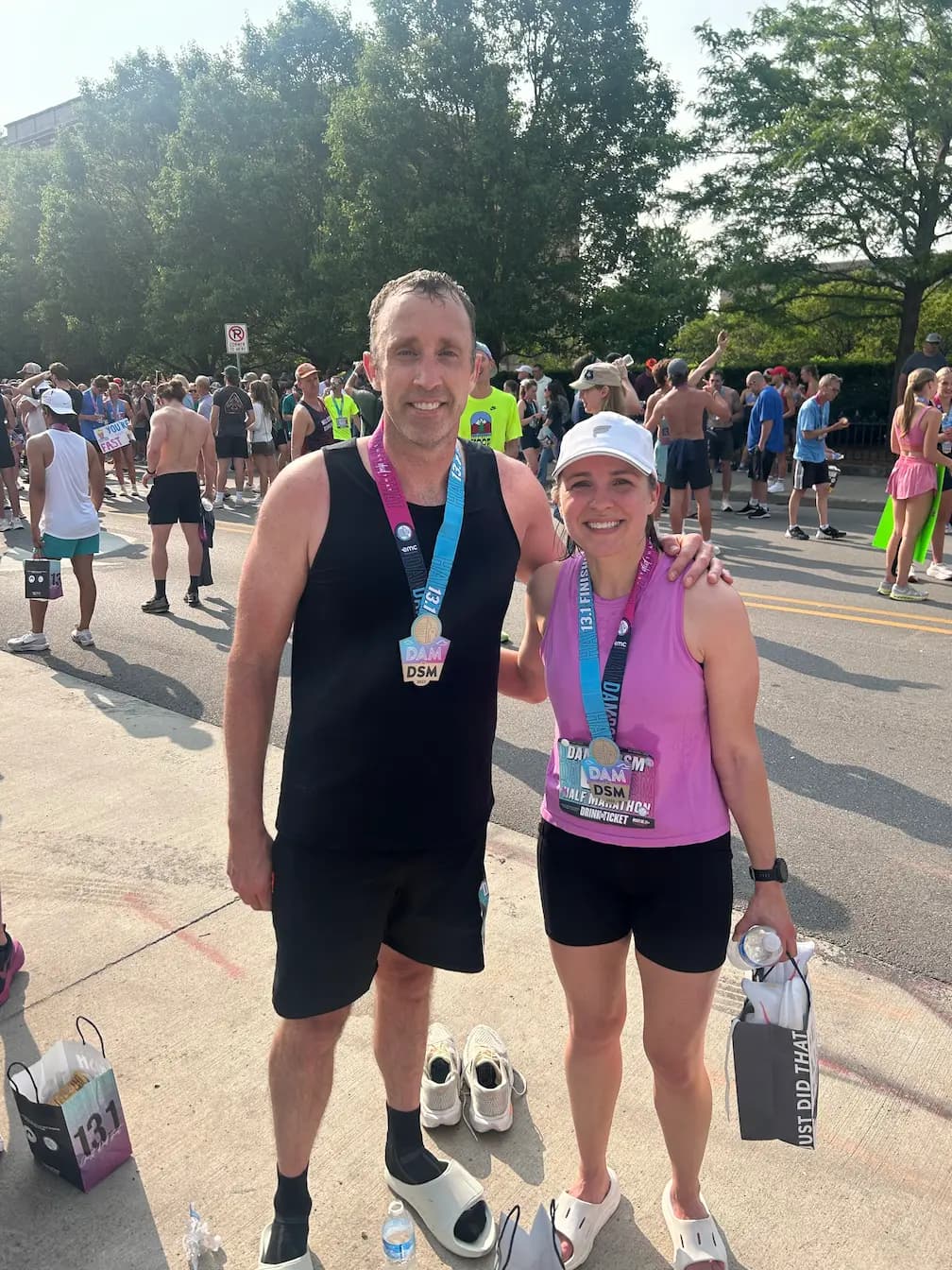
Phil Parker
Phil is a seasoned distance runner and web developer based in Iowa. He has run 15+ half marathons and 2 full marathons, and built PR Nerd because he was tired of paying for running apps that did not use real training science.
More about Phil →Comments
No comments yet. Be the first.
Leave a comment
Not published
0/1000
Ready to put this into practice?
Build your free personalized training plan based on your actual fitness — not your goal.
Build my plan →Get monthly running research, pace strategies, and fresh training articles. Zero fluff.